
/search_thin.svg)

/user.svg)
/cart.svg)
E-mail: info@energetickekameny.czTelefon: +420 606 647 298
SYENIT / SYENITE, energy – love – prosperity – protection
SYENITE ABILITIES OF THE STONE, ENERGY - PROTECTION - LOVE - PROSPERITY
Syenite is a product of the planet's volcanic activity, which accumulated terrestrial energy over millions of years. It is capable of continuously exchanging energy with a person. It helps harmonize the inner state and bring peace of mind and balance
- the stone is widely used in clairvoyance and extrasensory perception as a talisman
- it reveals talent, enhances abilities, helps expand the boundaries of the world around it, is effective in the hands of students, because it is able to help anyone who is drawn to new things, to discoveries, to understanding the universe and its laws
As an amulet, the mineral provides protection against rashes and hostile actions from outside. Many astrologers claim that for Taurus and Aries, a small syenite placed above the entrance to the house will protect against the evil eye and bad thoughts and create an atmosphere of love and prosperity.
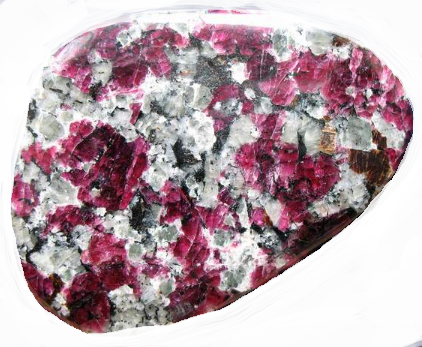
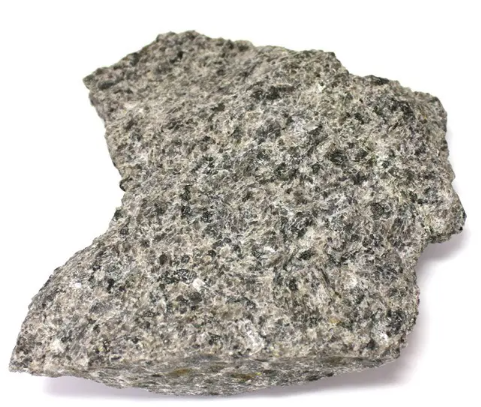
HEALTH EFFECTS
In folk medicine, it is believed that yellow and gray nepheline syenites have a beneficial effect on the gastrointestinal tract and increase appetite, while green and gray normalize the functioning of the nervous system and improve vision.
- the stone is widely used in Chinese and Tibetan medicine as a biostimulant on biologically active points of the body
- in Indian Ayurveda, small smooth round syenites relieve pain of various kinds and locations
- the stone has also found use in traditional medicine. Polished gabbro is used in massage procedures. In spa salons, massage with a mineral warmed to room temperature has a relaxing and revitalizing effect
COLORS AND VARIETIES
Depending on the mineralogical composition, syenites are divided into the following types:
- Sienodiorites (Diorites) are greenish-gray, medium-grained, with a spotted structure in which all minerals are clearly visible: magnetite, ilmenite, apatite, common hornblende. This massive stone is used in construction due to its properties: high hardness, brittleness, strength (it can only be ground with diamond).
- Monzonites (Gabbro) are black, dark green, spotted, smooth, evenly grained in structure, rich in plagioclase, quartz, chromite, and apatite. Gabbro is similar to diorite, but it has a dark color. It is used for the production of high-strength facing and building stones.
- Syenite - porphyry - gray, brown, containing large feldspar crystals, with a trachytic structure.
- Nepheline syenites are white, grayish, reddish, and greenish, closely resembling granite with many components: potassium feldspar, granular nepheline, titanium, enigmatite, chlorine, fluorine, phosphorus, and colored metals, which determine the color of the stone. It is a basic intrusive igneous rock.
The complex variable composition of nepheline syenite determined the appearance of several types of this mineral:
- Khibiny. They occur in the Khibiny Mountains and have a complex coarse-grained structure.
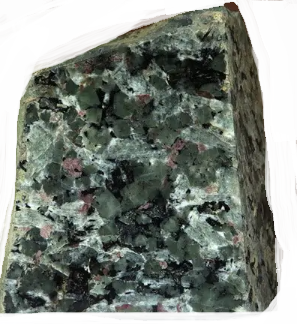
- Foyaita. A breed with large grains on a light gray background.
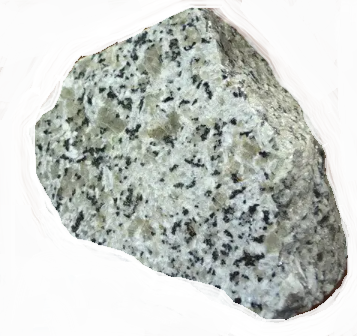
- Miaskites. A mineral with a wide range of colors: from gray to pink and dark gray. It contains zircon, corundum, and garnets, which make it look as though a sheen radiates through the thickness of the stone.
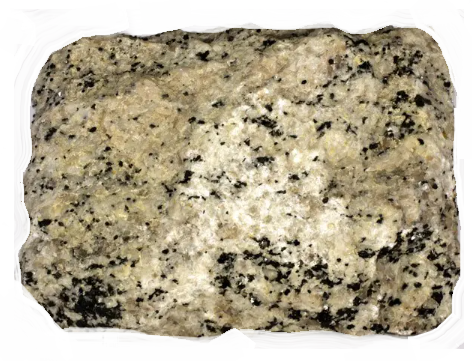
- Rischorrites. Thanks to biotite, the stones have a noble color: from deep green to gray ochre.
- Luyavrita. Due to saturation with alkalis, it has a black-green color and a striped structure.
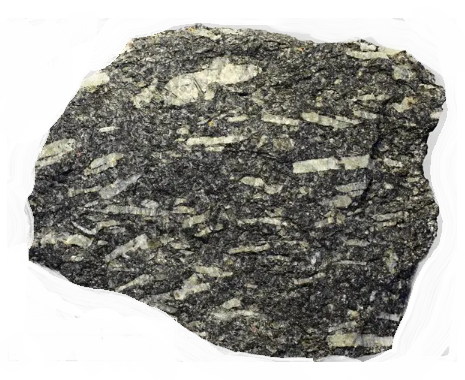
When weathered, nepheline syenite acquires a blue glow.
SITE
Syenite is often associated with granite, and therefore it is usually found near its deposits - in the marginal zone - in the form of massifs and veins. The stone is classified as an igneous rock located deep underground, although due to the planet's constant internal activity it is now often found on the surface.
This breed is one of the most widespread on Earth and occurs everywhere. Large deposits are located in North America (Arkansas and Wisconsin), Africa (South Africa, Kenya, Uganda), Brazil, Germany, and the Scandinavian islands. In Russia, syenite deposits were found in the Trans-Baikal Territory, on the Yenisei Ridge, and on the Kola Peninsula. And in the Sayan Mountains there is a reserve called the Krasnoyarsk Pillars. Bizarre columns and pillars create an otherworldly landscape here. They are bizarre blocks stacked on top of each other.
HISTORY AND TRADITION
Syenite is a magmatic, fully crystalline rock without quartz, of intermediate composition and moderately alkaline character.Outwardly, the stone resembles granite, but syenite is an independent group of stones that contain almost no quartz (less than 5%).
Syenite - a massive, hard rock, visually similar to granite.
- This stone began to be used in ancient Greece. Beautiful pinkish and gray stones were discovered near Song City, which are ideal for building or cladding houses and roads. Ts. Pliny then attributed the mineral to rocks under the general name Siena. And several centuries later in Germany near the city of Dresden, G. found Werner gave similar stones the name syenite based on ancient records and comparative analysis.
- In Russia, there are also surprisingly interesting descriptions of syenite, which were left by Prince Kropotkin in the 19th centuries on the way to Buryatia. He noticed that the mineral has a layered structure and is interspersed with granite.
- The world-famous sphinxes on Universitetskaya Embankment in St. Petersburg are carved from syenite and are approximately three and a half thousand years old.
- The Krasnoyarsk pillars of pink syenite “grew” on the body of a huge monolith. Many millions of years ago, during violent magmatic activity, molten magma was able to break through cracks within it and solidify on the surface, creating a magical image.
Syenite cannot be classified as a gemstone. It is not used in expensive jewelry. Its value, however, is different: it was and will remain a symbol of the eternity and inviolability of Nature, reminding us of human fragility and uncertainty.
All types of syenite are sought after by people in various areas of life because the costs of processing them are minimal.
- Nepheline syenite, which in geology belongs to the group of framework silicates, is used in:
- Construction: as crushed stone for roads and platforms around houses, interior and exterior cladding of houses, plinths, balconies, floors; in the production of anti-corrosion coatings for reinforced concrete structures.
- Chemical industry: in the production of cement, soda, alkalis, adhesives, gels, paper, and leather. From 30. years 20. for centuries has been widely used as a raw material for the production of alumina, which is essential in the manufacture of aluminum. It belongs among non-waste processes, because the by-products—soda and sludge—are used in the production of cement and silicate products, and in the glass and ceramic industries. Modern technology makes it possible to simultaneously isolate rare chemical elements: gallium, rubidium, and cesium.
- Agriculture: As part of a highly effective fertilizer for acidic soils. Such fertilizers are created on a potassium basis and are chlorine-free. They are absolutely harmless to soil, plants, and people. They reduce acidity, displace potassium, and create conditions for the rapid assimilation of nutrients by plants.
- For decorative purposes: for making sculptures, decorating fountains, stairs, making boxes, photo frames, writing sets
- Due to its color and structure, diorite is used for the production of slabs, pedestals, sculptures, stars, monuments.
- Gabbro is used in construction in the form of stone tiles, crushed stone, chips, high-strength facing material, as a raw material for stone casting, and in the production of mineral wool.
- Porphyry is one of the hardest rocks. They are a quarter harder than granite. This grade is used in construction and cladding. Porphyry facing tiles or paving stones last 14–15 years, which is twice the lifespan of granite tiles. Thanks to its high wear resistance, it is not afraid of impacts, sharp heels, or scratches. And its low thermal conductivity makes it an excellent thermally insulating finishing natural material. Porphyry has an amazing self-cleaning property. It allows the use of this mineral as a floor covering in factories and at gas stations, in car repair shops and car dealerships, where contamination of the floor with hard-to-remove petroleum-based substances is unavoidable. The spots will disappear in 2–3 weeks. The production of cladding panels requires no further processing, because cut stone has a pattern created by nature itself.
The decorative use of porphyry is due to the natural beauty of its pattern and it is used in ceilings and swimming pools. Ceiling tiles made from this mineral are capable of creating the effect of ancient Roman structures. The stone is beautifully colored and takes on any color.
PHYSICAL PROPERTIES
Syenite, a fully crystalline rock, was formed as a result of volcanic activity that continued on Earth for many thousands of years. The movement of magma and its continuous replenishment with new minerals created an interesting stone structure - a combination of small and large mineral grains in various shades of pink, gray, green, and dark colors.
Rock is most commonly composed of feldspars, dark-colored minerals, and silicon dioxide. And the concentration of acidic minerals makes syenite a basic rock.
| Property | Description |
|---|---|
| Hardness | 6 |
| Density | 2600 kg / m³ |
| Durability | 150-300 MPa |
| Clarity | 86% |
| Texture | Massive |
| Structure | Fully crystalline, evenly crystalline, sometimes porphyritic, fine- and medium-grained |
| Composition | Feldspar and dark-colored minerals |
| Form of occurrence | Dike and stocks |
| Genesis | Intrusive |
| Color | Light-colored rocks, grayish and pinkish, depending on the color of potassium feldspar and the content of dark-colored minerals |
Geologists often call the stone granite without quartz due to the absence of the radiant mineral in its composition.
This function removes the stone's shine. Syenite is generally very similar to granite, but it is more susceptible to weathering and its strength level is lower.Syenite is a coarse-grained intrusive igneous rock that forms through the slow cooling of molten lava beneath the Earth's surface.It has a general composition similar to granite.
- Ultraviolet light (UV) is light categorized between wavelengths of 100 nm and 400 nm.These wavelengths are shorter than what humans can see.
- Fluorescence is the emission of light by a substance that has absorbed light in the ultraviolet region of the spectrum and emits light in the visible spectrum.The emitted light has a longer wavelength and can therefore be visibly seen, unlike the exciting invisible UV wavelength.Fluorescence occurs at the atomic level.When a substance fluoresces, the electrons in the atoms reacting to UV light are excited by the wavelength and use the energy to jump away from the nucleus to a higher electron orbit.Nuclei do not like empty electron shells, so they pull electrons back down to fill the empty gap.This backward movement releases energy, which manifests as light in the visible spectrum.
- “Yooperlites” contain various sodalites with an impurity that reacts to the specific UV wavelength of 365 nm.This wavelength was developed for detecting cat urine and also for use in manufacturing processes.Fluorescent syenite has minimal fluorescence at a wavelength of 395 nm.
- In most cases, syenite is not fluorescent.In most cases, sodalite is also not fluorescent.It is assumed that the suspected source of this variety of syenite, which contains a fluorescent form of sodalite, originates from central Ontario.The rock was transported to the Michigan area 8,000 to 10,000 years ago by glaciers and/or icebergs on Lake Algonquin, a larger predecessor of Lake Superior.The eastern shore of Lake Algonquin was in the area of a fluorescent syenite deposit.Once all the fluorescent syenite samples have been collected from the beaches of Lake Superior, the supply will be gone, because it cannot be replenished—at least until another glacier scrapes across the landscape.So PLEASE, if you set out to look for these amazing rocks, take only a few and leave the rest for others to find.
- Some people tried to find fluorescent syenite during daylight hours.It is almost impossible, because syenite looks very similar to granite.Without a 365nm wavelength and the darkness needed to see its effect, there is no way to identify the fluorescent component during the day.
- Granite and syenite are similar in that they are intrusive igneous rocks formed by the slow cooling of molten magma beneath the Earth's surface.During cooling, minerals of the same type combine and form mineral grains.The slower the cooling, the larger the mineral grains.The difference between granite and syenite is primarily caused by the amount of quartz.Granite has more than 20 percent quartz as one of its components; syenite has five percent or less.