





E-mail: info@energetickekameny.czTelefon: +420 606 647 298
ORTHOCERAS FOSSIL – stability, direction, memory of ancient seas
ORTHOCERAS – THE STONE OF THE STRAIGHT PATH, INNER AXIS, AND THE ANCIENT OCEAN
STABILITY – DIRECTION – PERSEVERANCE – DISCIPLINE – PROTECTION – BALANCE – PURPOSEFULNESS – THE PAST – CALM – INNER STRENGTH – THE MEMORY OF THE EARTH – LIFE PATH
“Some paths wind in a spiral. Others go straight ahead. It is important to know where we are heading."
Orthoceras is among the fossils that at first glance look almost geometric. A long, slender case divided by regular partitions resembles an arrow, a tower, or an axis pointing in a single direction.
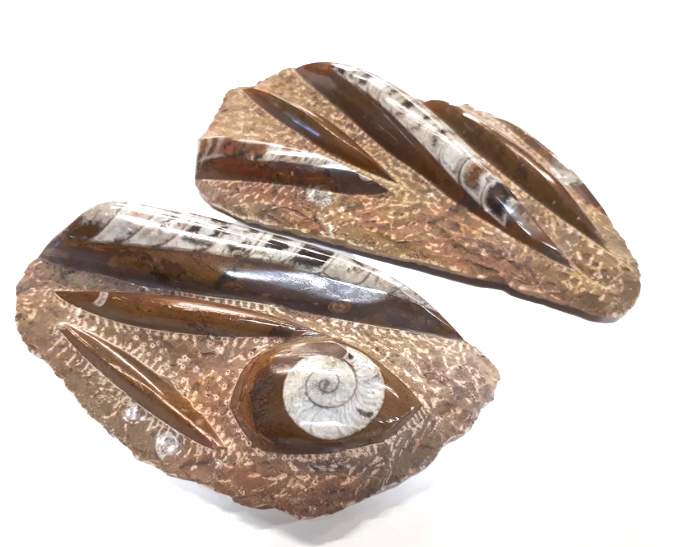
Under the trade name Orthoceras, fossils of straight-shelled cephalopods from Morocco are primarily sold today, especially from the Anti-Atlas region. Many originate from the Upper Devonian and are approximately 370 million years old. More precisely, however, it is not always the genus Orthoceras – several related genera occur in the same rocks, for example Michelinoceras or Arionoceras. The name “Orthoceras” therefore often functions in jewelry and commercial contexts as a broader designation for straight orthocerid cephalopods.
SOUL OF THE FOSSIL
While the ammonite symbolizes the spiral and returns, Orthoceras has an entirely different effect.
It is direct.
Elongated.
Clearly oriented.
Therefore, in modern symbolism it is suited to themes of direction, focus, and life purpose.
It reminds a person that there is no need to constantly change direction just because the path is not fast.
Sometimes the greatest strength is simply to keep going in the right direction.
ABILITIES
In modern esoteric traditions, Orthoceras is associated with:
- stability,
- grounding,
- discipline,
- perseverance,
- focus,
- a clear direction,
- long-term goals,
- protection,
- calm,
- balance,
- the ability to learn from the past,
- patience,
- support during changes,
- a sense of a solid foundation.
STONE OF DIRECTION
The shape of Orthoceras is its strongest symbol.
Unlike spiral ammonites, it has an elongated conical shell.
In a modern interpretation, it can therefore represent: “I know where I come from. And I know where I want to go.“
It is suitable for a period when we have too many options, plans, or ongoing projects and need to choose one real direction.
ENDURANCE
Orthocerid cephalopods survived in the oceans for an immensely long part of Earth's history.
Their fossils remind us today that success in nature is not just a matter of strength.
It is also a matter of adaptation, perseverance, and the ability to function in a changing world.
Therefore, Orthoceras can be a suitable symbol for people who are working on something long-term.
WORK AND BUSINESS
In modern times, Orthoceras is sometimes used as a stone of work stability and concentration.
It is suitable for symbolic support:
- long-term projects,
- study,
- planning,
- organization,
- business,
- work requiring discipline.
Does not guarantee success.
However, it is a beautiful reminder that the result often arises from many small steps in the same direction.
WHAT WAS ORTHOCERAS?
Orthoceras was not a stone.
It was a marine cephalopod.
It belonged to the group of extinct orthocerids – animals related to present-day cephalopods.
Their body lived in the open front part of the long shell. Older sections were separated by partitions and formed chambers.
As with other chambered cephalopods, the chamber system helped regulate buoyancy.
IT WAS NOT A SHELL
Orthoceras is sometimes incorrectly described as a “shell”.
That is not accurate.
He was not a man.
It was a cephalopod, that is, a distant relative of today's:
- octopuses,
- squids,
- cuttlefish,
- nautiluses.
It had tentacles and moved actively in the water. Orthocerid cephalopods are assumed to have moved by jet propulsion, similarly to modern cephalopods.
COMPARTMENTED BOX
The box was divided inside by partitions – septa.
As the animal grew, it added new chambers and its body moved into the larger living chamber at the open end.
Through the chambers ran the siphuncle, a system of tissues important for regulating fluids and gases in the chambers and thus buoyancy.
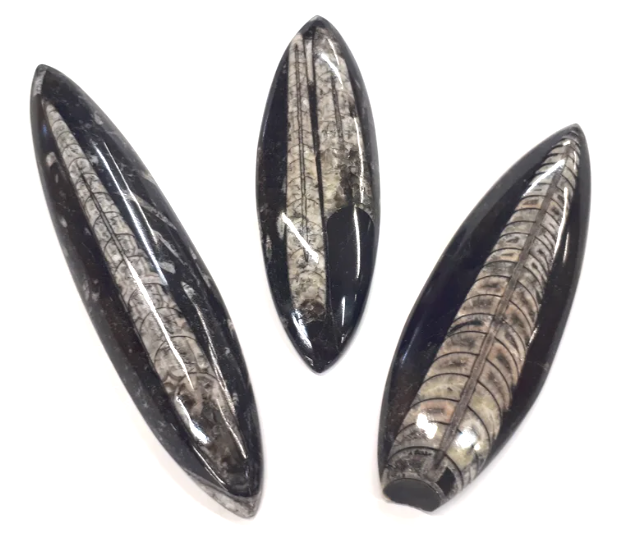
It is precisely the chambers that today create their characteristic regular pattern on cut and polished fossils.
HOW OLD IS ORTHOCERAS?
Here it is necessary to distinguish between the trade name and the specific genus.
The genus Orthoceras has a very ancient fossil record, and orthocerid cephalopods as a broader group existed for much of the Paleozoic and extended into later periods. The Mindat database lists a fossil record for the genus Orthoceras from the early Paleozoic and a broader persistence of orthocerid lineages deep into the geological past.
Moroccan material commonly sold as “Orthoceras” often comes from the Upper Devonian, approximately 370 million years ago.
Therefore, the original figure of 350–400 million years for common Moroccan specimens is reasonable.
MOROCCO AND ERFOUD
The city of Erfoud in southeastern Morocco has become one of the world's best-known centers of the fossil trade.
In the wider Anti-Atlas region, sedimentary rocks rich in Paleozoic marine fossils can be found.
In addition to straight-shelled cephalopods, for example, the following can be found here:
- trilobites,
- goniatites,
- ammonoids,
- other cephalopods,
- various marine organisms.
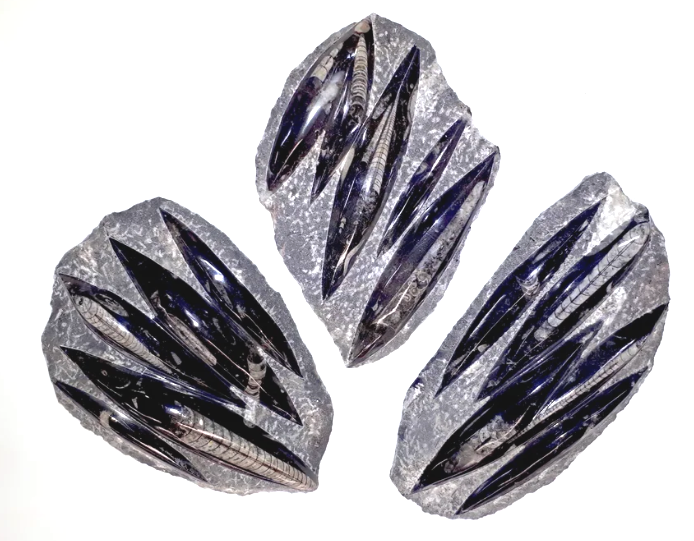
The local fossiliferous rock is often cut and polished into tabletops, bowls, obelisks, eggs, or decorative slabs.
WHY IS IT OFTEN BLACK?
Typical Moroccan products with Orthoceras are usually black to dark gray with white or gray fossil patterns.
The dark background consists of the sedimentary rock in which the fossils were preserved.
After cutting and polishing, a striking contrast emerges between the dark rock and the light mineralized shell.
It is precisely this contrast that made Moroccan Orthoceras a popular decorative material.
NOT EVERY “ORTHOCERAS” IS THE TRUE GENUS ORTHOCERAS
This is a very important interesting fact for Atlas.
In the shop, the term Orthoceras is often used generally for long, straight fossil cephalopods.
In fact, individual specimens may belong to other genera, for example Michelinoceras or Arionoceras. For a typical polished specimen, precise species identification is often difficult.
Therefore, for products I would use the safe designation: ORTHOCERAS – FOSSIL OF A STRAIGHT-SHELLED CEPHALOPOD
And in the detailed description, it can be explained that this is a traditional trade name.
ORTHOCERAS AND AMMONITE – WHAT IS THE DIFFERENCE?
At first glance, very simple:
ORTHOCERAS – a straight or almost straight conical shell.
AMMONITE – typically a spirally coiled shell.
Both belong among extinct cephalopods, but they represent different evolutionary groups.
They therefore complement each other beautifully on a symbolic level.
AMMONITE – spiral, cycles, transformation.
ORTHOCERAS – direction, axis, discipline.
ORTHOCERAS AND TIME
When we hold a fossil approximately 370 million years old, the concept of “old” begins to mean something entirely different.
At the time when these cephalopods lived:
- humans did not exist,
- mammals did not exist in their present form,
- dinosaurs were not yet the dominant group,
- the world’s continents had a completely different arrangement.
Their shells sank to the seabed, were buried in sediment, and after hundreds of millions of years came back to light.
Orthoceras is therefore literally a touch of deep time.
TRADITIONALLY ATTRIBUTED HEALTH EFFECTS
In modern lithotherapy, Orthoceras is sometimes claimed to have:
- vitality,
- bones,
- spine,
- digestion,
- nervous system,
- regeneration.
These effects are not scientifically proven.
A fossil can be a beautiful symbol of stability and resilience, but it does not treat diseases of the bones, spine, or other organs.
CHAKRAS
Orthoceras is most commonly associated with: ROOT CHAKRA – stability, safety, grounding.
The dark color of the surrounding rock and the ancient origin of the fossil fit well with modern symbolism of the Earth and rootedness.
The elongated shape is sometimes also associated with the idea of the body axis and the flow of energy, but that belongs to the esoteric tradition, not to paleontology.
ZODIAC SIGNS
Orthoceras does not have a single historically fixed astrological sign.
In modern terms, it can be associated, for example, with:
Capricorn – discipline and long-term goals
Taurus – stability and Earth
Virgo – organization and practicality
Scorpio – deep past and transformation.
However, no sign has it prescribed or prohibited.
COLOR
The most common combination we encounter is:
- black,
- dark gray,
- gray,
- white,
- cream,
- brownish.
The fossil itself may have a different color depending on the minerals that filled or replaced the original shell during fossilization.
PHYSICAL PROPERTIES
Orthoceras is not a single mineral, so it cannot be assigned one universal chemical formula or one hardness value.
Type: fossil of a marine cephalopod
Original shell: calcium carbonate, predominantly aragonite
Current composition: depends on mineralization and the surrounding rock
Shape: straight to slightly curved conical shell
Internal structure: chambers separated by septa
Characteristic feature: longitudinal siphuncle and chambering
Age of common Moroccan material: often around 370 million years old
Environment: marine.
JEWELRY AND DECORATIONS
Orthoceras is used primarily as a decorative fossil.
We can find it in the form of:
- pendants,
- cabochons,
- bracelets,
- necklaces,
- polished slabs,
- bowls,
- obelisks,
- eggs,
- table decorations,
- bookends,
- tabletops.
Large slabs with several fossils are often very impressive because they show an entire community of cephalopods preserved in a single layer of rock.
COMBINATIONS
for stability: petrified wood, jasper, smoky quartz
for working with the past: ammonite, fossil coral, amber
for discipline: tiger's eye, hematite
for grounding: black tourmaline, obsidian
for change: labradorite
for focus: fluorite, sodalite.
A very interesting combination is Orthoceras + ammonite.
One symbolizes the straight direction.
The second spiral development.
Together, they remind us that sometimes we need a firm goal and at other times the ability to change course.
CLEANING AND CARE
Gentle care is recommended for Orthoceras, because we do not always know the exact mineralization of the fossil or the properties of the surrounding rock.
The safest option is:
- soft dry cloth,
- or a slightly damp cloth,
- followed by immediate drying.
Avoid:
- prolonged soaking,
- salt water,
- vinegar and acids,
- aggressive cleaning agents,
- ultrasound,
- steam,
- sudden temperature changes.
ENERGY CLEANSING
For symbolic energy cleansing, we recommend:
- smoke,
- sound,
- moonlight,
- placing next to crystal,
- personal intention.
Dry methods are the safest.
CHARGING
Orthoceras can be symbolically charged:
- on dry land,
- in the moonlight,
- next to crystal,
- through meditation.
Because it is a fossil hundreds of millions of years old, in modern symbolism it is naturally associated primarily with the element of Earth.
CRYSTAL WATER
I would not place Orthoceras directly into drinking water.
A fossil may be composed of a mixture of minerals, the surrounding rock may contain various impurities, and decorative products may additionally be polished, stabilized, or glued.
For symbolic use, we recommend only the indirect method.
"ONE DIRECTION" RITUAL
Place the Orthoceras in front of you so that its tip points away from you.
Write down three things you want to achieve.
Then ask yourself: “Which of them is really the most important right now?“
Select one.
And write the first step.
No ten steps.
One.
Orthoceras can be a reminder of a simple principle: When we know where we’re going, we don’t have to run. Just don't stop.
WHY CHOOSE ORTHOCERAS
Because it is simple and yet incredibly ancient.
Its line is straight.
Its story goes back hundreds of millions of years.
It once belonged to a living marine cephalopod that swam in the ocean of a world that no longer exists.
Today, we see its chambers as regular light lines in the dark rock.
There is something almost architectural about it.
Order.
Rhythm.
Direction.
And at the same time, the deep past.
ORTHOCERAS – THE FOSSIL OF A DIRECT PATH. IT REMINDS US THAT WE DO NOT NEED TO KNOW THE WHOLE PATH IN ADVANCE. It is enough to know which direction we want to go – and take the next step.
The spiritual, protective, chakra, and esoteric properties of Orthoceras are based on modern lithotherapeutic and symbolic traditions. They are not a scientifically proven treatment or a guarantee of the stated results, and they do not replace professional medical or psychological care.


