/search_thin.svg)

/user.svg)
/cart.svg)
E-mail: info@energetickekameny.czTelefon: +420 606 647 298
FOSSIL SHARK TOOTH – strength, courage, instinct
OTODUS OBLIQUUS – TOOTH OF AN ANCIENT PREDATOR AND A SYMBOL OF STRENGTH, RENEWAL, AND SURVIVAL
STRENGTH – COURAGE – PROTECTION – INSTINCT – PERSEVERANCE – RENEWAL – SELF-CONFIDENCE – DETERMINATION – SURVIVAL – PURPOSEFULNESS – INNER STRENGTH – MEMORY OF THE EARTH
“Strength does not mean never losing anything. Strength is being able to continue again."
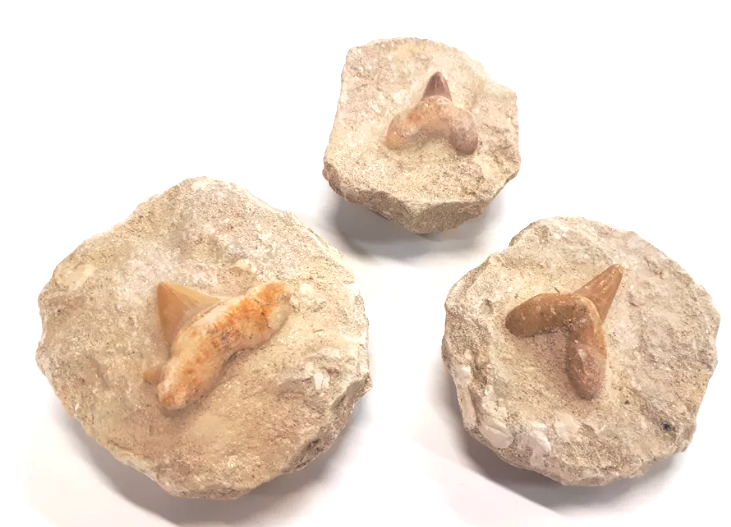
A fossil shark tooth is one of those fossils for which we can imagine the past almost immediately. It was not a motionless shell on the seabed. It was part of the jaw of a large predator that roamed the ancient ocean tens of millions of years ago.
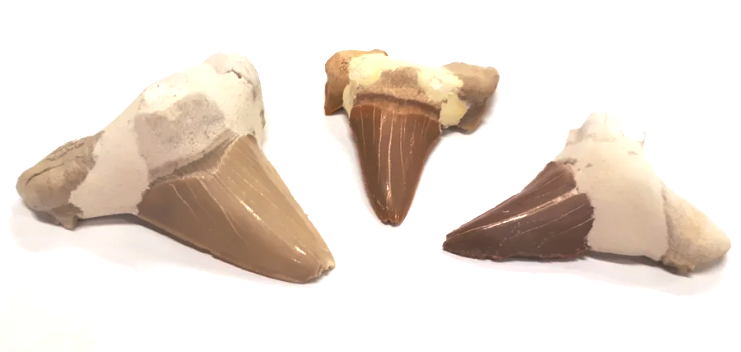
Teeth of the species Otodus obliquus are characterized by a tall central crown with smooth cutting edges and smaller lateral points – cusplets. This very tooth structure belongs among its characteristic features and at the same time represents an early stage in the evolution of the famous lineage of megatooth sharks.
SOUL OF THE FOSSIL
A shark tooth has very different symbolism from an ammonite, coral, or trilobite.
It is sharp.
Straightforward.
Functional.
It originated as a survival tool.
Therefore, it can symbolize a moment when merely thinking is no longer enough and we need to make a decision.
A shark tooth reminds us that courage is not the absence of fear. It is the ability to keep going even when we feel fear.
ABILITIES
In modern symbolism, a fossil shark tooth can be associated with:
- courage,
- inner strength,
- self-confidence,
- determination,
- protection,
- the ability to defend one’s own boundaries,
- instinct,
- perseverance,
- overcoming fear,
- the ability to start again,
- focus on the goal,
- life energy,
- adaptability,
- the ability to survive difficult periods.
RENEWAL – THE STRONGEST SYMBOL OF THE SHARK TOOTH
Sharks have something that our human teeth cannot do.
They continuously replace teeth.
New teeth form in their jaws and gradually move into a functional position. A shark can therefore lose and replace an enormous number of teeth during its lifetime. That is precisely why shark teeth are such a common part of the fossil record. The Florida Museum states that sharks can shed many thousands of teeth during their lifetime.
And it is precisely here that this fossil has a beautiful message.
Losing something does not mean the end.
Something will break.
A space will be created.
And life goes on.
WHEN WE LOSE SOMETHING
A shark does not think about the tooth it has lost.
He has another one ready.
Humans naturally function differently, but as a symbol it is very powerful.
It can remind us of a period when we lost a job, a relationship, a plan, a sense of security, or something we were convinced we could not go on without.
A shark tooth can be a symbol of the sentence: “What I lost does not have to be the end of my story.“
WHAT WAS OTODUS OBLIQUUS?
Otodus obliquus was a large extinct shark that lived in the early Tertiary period.
It is known primarily from fossil teeth, because sharks' skeletons are composed mainly of cartilage and fossilize significantly worse than mineralized teeth. The Florida Museum explains that this is precisely why teeth make up the most common part of the shark fossil record.
Otodus obliquus was a large ocean predator.
Estimates of its maximum size vary because we do not have a complete skeleton, and its length is reconstructed primarily from teeth and comparisons with related sharks. Therefore, I would not state the original figure of 9–12 meters as a certain exact size, but rather, for example:
“A large prehistoric shark, whose maximum length is estimated according to various reconstructions to have been several meters, and in the largest individuals may have been significantly greater.“
This way, we will not present an uncertain paleontological estimate to the customer as a measured fact.
ANCESTOR OF THE MEGALODON?
Here we have a beautiful curiosity.
Otodus obliquus is among the oldest members of the evolutionary lineage of large megatoothed sharks.
The Florida Museum shows the evolution of teeth from Otodus obliquus, which had smooth cutting edges and prominent lateral cusplets, through later forms with serrated edges, to the megalodon, whose massive teeth no longer had lateral cusplets.
So we can say, in simplified terms: Otodus obliquus belonged to an early evolutionary lineage from which the giant megatoothed sharks, including megalodon, later emerged.
In my opinion, this is one of the strongest points of interest in the entire article.
HOW TO IDENTIFY AN OTODUS OBLIQUUS TOOTH
A typical tooth may have:
- a high main crown,
- smooth cutting edges without pronounced serrations,
- a robust root,
- smaller points on the sides of the main crown – cusplets.
However, the shape changes depending on exactly where the tooth was located in the jaw.
The front tooth is not the same as the side tooth.
The upper and lower teeth may also differ.
Therefore, accurately identifying fossil shark teeth is more complicated than it may seem at first glance. The Florida Museum notes that tooth morphology depends on its position in the jaw, the shark’s age, and other factors, and identification down to the species level can be difficult even for experts.
KHOURIBGA – MOROCCO
Your location Khouribga in Morocco makes very good sense.
Morocco is world-renowned for the abundance of fossil shark teeth, and Otodus obliquus is scientifically documented from the Early Eocene strata of Morocco. For example, the Florida Museum records a scientific paper directly devoted to Otodus obliquus from the early Eocene – Ypresian – in Morocco.
The Khouribga region and the broader Ouled Abdoun Basin are known for phosphate sediments exceptionally rich in fossils of marine vertebrates.
HOW OLD IS HE?
For Moroccan specimens of Otodus obliquus, we commonly place them in the early Eocene, approximately 50–56 million years ago. Specialized works from Morocco place it specifically in the Ypresian, the oldest stage of the Eocene.
“Approximately 50–55 million years ago, early Eocene.“
THE WORLD 50 MILLION YEARS AGO
When this shark swam in the sea, the world looked completely different.
The dinosaurs were already gone.
Mammals evolved rapidly and occupied environments left vacant after the mass extinction.
The climate was significantly warmer than today, and ocean levels as well as the distribution of continents were different.
And in the North African seas swam large sharks, whose teeth we now find in the Moroccan desert.
What is dry land today was once sea.
That is exactly what makes fossils so fascinating.
WHY DO WE FIND SO MANY SHARK TEETH?
A shark tooth is one of the most common vertebrate fossils.
There are two reasons.
First, sharks produce and lose an enormous number of teeth during their lifetime.
Secondly, they have a skeleton made mostly of cartilage, which decomposes after death and fossilizes much less readily.
Teeth, on the other hand, are highly mineralized and have a much greater chance of surviving for millions of years.
Therefore, we can find thousands of teeth, although a complete fossil shark skeleton is extremely rare.
HOW DOES A TOOTH TURN INTO A FOSSIL?
After being knocked out, the tooth must be placed in an environment suitable for preservation.
If it is quickly buried in sediment on the seabed, the sediment protects it from mechanical damage, oxygen, and organisms that would otherwise decompose it.
Water containing dissolved minerals can gradually pass through it. These penetrate the pores and, over the course of a long process, participate in the permineralization of the fossil.
Therefore, the tooth we hold in our hand today is not simply an “old white shark tooth.”
It is a material that has undergone geological changes lasting millions of years.
WHY ARE FOSSIL TEETH BLACK, GRAY, OR BROWN?
The live shark did not have black teeth.
The color of the fossil developed only after its deposition.
Minerals from the surrounding sediment penetrate the tooth structure during fossilization and may discolor it:
- black,
- gray,
- brown,
- beige,
- reddish,
- greenish,
- bluish.
The Florida Museum explains that the color of fossil teeth is significantly influenced by the minerals present in the surrounding sediments.
The color of the tooth is therefore also a trace of the environment in which it fossilized.
INSTINCT
In modern symbolism, the shark is often associated with instinct.
A fossil tooth can therefore symbolize the ability to perceive a situation and trust one’s own judgment.
It does not mean acting thoughtlessly.
On the contrary.
It can resemble the difference between: fear that paralyzes us, and instinct that warns us.
PROTECTION AND BOUNDARIES
Shark teeth are used in many modern amulets as a symbol of protection, strength, and courage.
Their sharp shape naturally invites it.
For us, a tooth can also symbolize healthy boundaries.
We don't have to attack.
But we have the right to protect our space.
SELF-CONFIDENCE AND COURAGE
A fossil shark tooth can be a beautiful talisman for a person who needs to make a decision, stand up for themselves, or overcome a period of uncertainty.
His message is not: “Do not be afraid of anything.“
Much better is: “Don’t let fear decide for you.“
TRADITIONALLY ATTRIBUTED HEALTH EFFECTS
In various modern esoteric sources, shark teeth and fossils are associated with themes of vitality, strength, regeneration, and physical resilience.
Such effects have not been scientifically proven.
A fossil tooth can be a symbol of strength and renewal, but it does not cure diseases, strengthen the immune system, or speed up healing.
CHAKRAS
In modern crystal therapy, a fossil shark tooth can be associated primarily with the: ROOT CHAKRA – survival, stability, safety, strength, and grounding.
Sometimes also with the: SOLAR PLEXUS – self-confidence, determination, and personal power.
This is a symbolic esoteric attribution, not a biological property of the fossil.
ZODIAC SIGNS
A fossil shark tooth does not have one traditional astrological sign.
In modern times, it can be symbolically associated, for example, with:
Scorpio – strength, instinct, and survival
Aries – courage and action
Capricorn – perseverance
Leo – confidence.
Of course, no sign has it prohibited.
ELEMENT
Symbolically, I would place here above all: WATER – origin and the primordial ocean
and at the same time: EARTH – fossilization, stability, and preservation for millions of years.
As with other fossils, two worlds are connected here.
Life began in water.
The earth preserved his trace.
PHYSICAL PROPERTIES
A fossil shark tooth is not a mineral, so it does not have a single simple chemical formula like quartz or calcite.
Type: vertebrate fossil
Animal: Otodus obliquus
Group: extinct large shark
Age of Moroccan specimens: often Early Eocene, approximately 50–55 million years
Locality: Morocco, Khouribga / Ouled Abdoun area
Original material: highly mineralized dental tissue
Preservation process: fossilization and permineralization
Typical feature: large main crown and lateral cusplets
Cutting edge: in O. obliquus typically smooth.
COLLECTIBLES AND JEWELRY
Fossil shark teeth are popular as:
- individual collectible fossils,
- pendants,
- necklaces,
- decorations,
- educational specimens,
- gifts for lovers of paleontology and the sea.
For larger and higher-quality teeth, the value is mainly influenced by:
- species,
- size,
- completeness,
- condition of the crown,
- condition of the root,
- condition of the lateral cusplets,
- locality,
- any repairs or reconstruction.
For a collector's item, it is good to state if a tooth has been glued or reconstructed.
COMBINATIONS
for courage: carnelian, tiger's eye
for strength: garnet, hematite
for protection: obsidian, black tourmaline
for stability: petrified wood, Orthoceras
for transformation: ammonite, labradorite
for connection with the ancient sea: fossil coral, ammonite.
A thematic collection can also be beautiful: AMMONITE – EVOLUTION
ORTHOCERAS – DIRECTION
TRILOBITE – ADAPTATION
SHARK TOOTH – STRENGTH AND RENEWAL
Four fossils and four different stories of survival.
CLEANING AND CARE
I would clean the fossil tooth very gently.
The safest option is:
- soft dry brush,
- soft cloth,
- if necessary, a slightly damp cloth,
- subsequent thorough drying.
Avoid prolonged soaking, salt water, acids, vinegar, harsh chemicals, ultrasound, steam, and mechanical scrubbing.
With fossils, moreover, we do not always know whether they were stabilized or repaired during preparation.
ENERGY CLEANSING
The safest methods are dry methods:
- smoke,
- sound,
- moonlight,
- placing next to crystal,
- personal intention.
Due to energetic cleansing, there is no reason to soak the fossil.
CHARGING
Symbolically, a fossil shark tooth can be charged:
- in the moonlight,
- on dry ground,
- next to crystal,
- through meditation and your own intention.
The sea is beautifully connected to its story, but there is no need to place the fossil in salty seawater.
CRYSTAL WATER
I would not place a fossil shark tooth directly into drinking water.
We do not always know the exact mineral admixtures formed during fossilization, nor any conservation, adhesive, or surface treatments that may have been applied.
If you want to use it symbolically, we recommend only the indirect method.
"NEW TOOTH" RITUAL
Take the fossilized shark tooth in your hand and remember something you have lost.
It doesn't have to be a person.
It could be work.
Plan.
Opportunity.
A feeling of certainty.
Or an idea of what your life was supposed to look like.
Then remember the shark.
The tooth fell out.
But another was already growing behind it.
Ask yourself the question: “What can grow in the place of what I have lost?“
And then the second: “What first step can I take toward that?“
Not everything can be replaced.
But loss does not always have to mean the end.
Sometimes it creates space for something that could not have come into being before.
WHY CHOOSE A FOSSIL SHARK TOOTH
Because approximately 50 million years ago, it was not an ornament.
He was a tool of a true predator.
It helped him hunt and survive in the primordial ocean.
Then he dropped out.
He sank to the seabed.
It was covered by sediment.
Minerals slowly penetrated its structure.
The sea disappeared.
The landscape has changed.
Tens of millions of years passed.
And the tooth reappeared – this time in the land of Morocco.
What was once lost and forgotten at the bottom of the ocean, today we hold in our hands.
FOSSIL SHARK TOOTH – A SYMBOL OF STRENGTH, INSTINCT, AND RENEWAL. IT REMINDS US THAT LOSS DOES NOT HAVE TO BE THE END. SOMETIMES IT'S JUST A PLACE WHERE SOMETHING NEW BEGINS TO GROW.
The spiritual, protective, chakra, and esoteric properties of a fossil shark tooth stem from cultural, symbolic, and modern lithotherapeutic traditions. They are not a scientifically proven treatment or a guarantee of protection or the stated results, and they do not replace professional medical or psychological care.