/search_thin.svg)

/user.svg)
/cart.svg)
E-mail: info@energetickekameny.czTelefon: +420 606 647 298
CALYMENE TRILOBITE FOSSIL – protection, perseverance, transformation, and the memory of the Earth
CALYMENE TRILOBITE – A MESSENGER FROM ANCIENT SEAS AND A SYMBOL OF THE ABILITY TO SURVIVE
PERSEVERANCE – PROTECTION – TRANSFORMATION – STABILITY – ADAPTABILITY – INNER STRENGTH – DETERMINATION – THE PAST – WISDOM – GROUNDEDNESS – THE MEMORY OF THE EARTH – LIFE PATH
“Surviving does not mean never changing. It means being able to change while continuing."
The trilobite is among the most famous inhabitants of the ancient oceans. Its body was protected by a hard segmented exoskeleton, it had a segmented body, and in many species also surprisingly advanced compound eyes.
The first trilobites appeared as early as the beginning of the Cambrian, more than 500 million years ago, and their evolutionary story continued for nearly 270 million years. They survived several global crises before the last of them disappeared during the great extinction at the end of the Permian approximately 252 million years ago.
SOUL OF THE FOSSIL
The trilobite is a symbol of perseverance.
Its group existed on Earth longer than the dinosaurs and incomparably longer than modern humans.
The continents were shifting.
The seas came and disappeared.
The climate was changing.
Major extinctions were taking place.
And trilobites again and again occupied new environments and evolved new forms.
Therefore, their fossil may remind us: Strength does not lie in remaining forever the same. Sometimes it is precisely the one who can adapt who survives.
ABILITIES
In modern symbolic and esoteric interpretation, the trilobite can be associated with:
- endurance,
- protection,
- adaptability,
- stability,
- resilience,
- overcoming difficult periods,
- grounding,
- long-term goals,
- working with the past,
- self-knowledge,
- the ability to learn from experience,
- trust in one’s own strength,
- life transformation.
But the best thing about the trilobite is that a large part of this symbolism comes directly from its actual evolutionary history.
PROTECTIVE SHELL
Trilobites were arthropods, and their bodies were protected by a hard mineralized outer skeleton – an exoskeleton.
It had several functions.
It protected the soft body, provided support, and at the same time enabled movement thanks to segmentation.
The rigid exoskeleton is also one of the reasons why we have such a rich fossil record of trilobites. The British Geological Survey states that fossils often preserve their hard outer shells or their impressions.
Symbolically, the trilobite therefore beautifully combines two qualities: protection and mobility.
A hard shell did not mean staying in one place.
CALYMENE – "ROLL UP AND PROTECT YOURSELF"
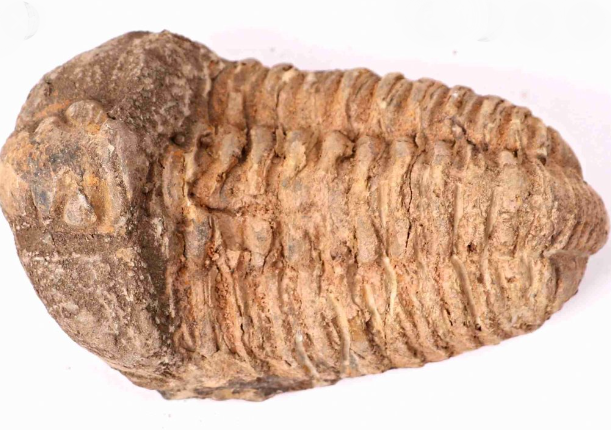
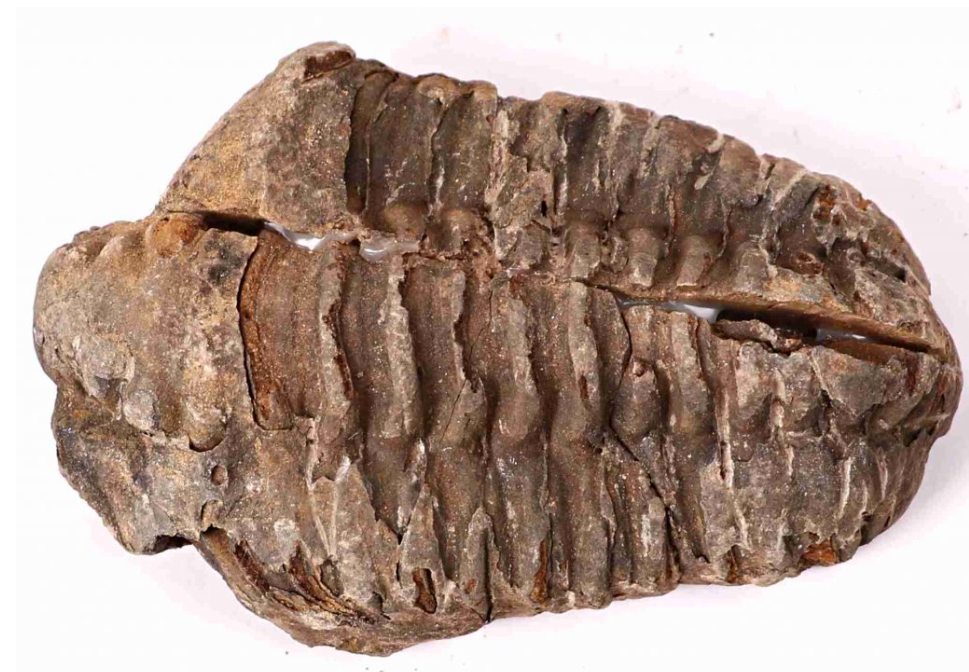
The genus Calymene and its relatives are particularly interesting for their ability of enrollment – rolling the body into a ball.
Just like today’s pill bug, the trilobite could curl up when in danger so that the soft underside of its body remained protected inside its hard shell.
The British Geological Survey directly describes this method of defense in Calymene.
This makes it a beautiful symbol of healthy boundaries.
Sometimes it is right to go out and fight.
And sometimes it is right to withdraw, protect yourself, and wait until the danger passes.
WHAT IS A TRILOBITE?
Trilobites were marine arthropods.
They belonged to the same large phylum of animals as today's:
- crustaceans,
- spiders,
- scorpions,
- insects,
- centipedes.
So they are neither shellfish, nor corals, nor cephalopods.
Their name comes from the characteristic division of the body into three longitudinal lobes.
From here: TRI = three
LOBUS = lobe
that is, approximately “three-lobed”.
THREE PARTS OF THE BODY
In addition to the three longitudinal lobes, the trilobite's body was also divided transversely.
It had: CEPHALON – head
THORAX – segmented thoracic part
PYGIDIUM – rear part of the body
The genus Calymene usually had around 13 thoracic segments.
It is precisely the regular segmentation that gives fossils their characteristic almost mechanical appearance.
TRILOBITES HAD EYES
One of the most amazing things about trilobites is their eyes.
Many species had compound eyes made up of a larger number of individual lenses, similar to modern insects.
Depending on the species, the size and structure of the eyes varied greatly. Some species had a wide field of vision, others had reduced eyes, and there were even completely blind trilobites.
Even more amazing is the material of their lenses.
In a number of trilobites, they were composed of calcite.
It is one of the oldest known sophisticated optical systems in the history of animals.
HOW DID THE TRILOBITE GROW?
The trilobite had a hard exoskeleton.
However, it could not simply grow larger along with the body.
Like today’s arthropods, trilobites therefore shed their old exoskeleton—they molted.
After shedding, the new shell was softer for some time and could expand.
At fossil sites, we therefore often do not find a dead trilobite, but only its shed exoskeleton.
The British Geological Survey points out that it was precisely during molting that the exoskeleton often split along the facial sutures, which explains the abundance of individual trilobite parts in the fossil record.
POWERFUL SYMBOLISM: SHEDDING THE OLD SHELL
This real biological trait is beautiful for Atlas.
For the trilobite to grow, it had to shed the shell that had protected it until then.
What still felt safe yesterday began to feel too confining.
And that is exactly how human life sometimes works too.
Some things protect us for a certain period of time. Then comes the moment when we must leave them behind so that we can continue to grow.
CALYMENE – WHAT IS IT, REALLY?
Calymene is a genus of trilobites belonging to the family Calymenidae.
Typical species were relatively small. They typically measured several centimeters and had a rounded, robust body capable of curling up.
The genus is known mainly from the Silurian, although records of related forms and specimens that have historically been classified in various ways also extend into the Ordovician and other periods.
MOROCCAN “CALYMENE” – A SMALL PALEONTOLOGICAL PUZZLE
You need to be careful with Moroccan fossils.
The simple name Calymene is very often used in shops, but paleontological collections from Morocco commonly record, for example, the genus Flexicalymene, especially the species Flexicalymene ouzregui.
Calymene and Flexicalymene are related genera, but they are not identical.
Therefore, for an ordinary piece without expert identification, I would use a safer description:
CALYMENID-TYPE TRILOBITE / COMMERCIALLY CALYMENE
If the supplier provides the exact location and species identification, we can of course use a more precise name.
IS IT 460 MILLION YEARS OLD?
It can be. But it doesn't have to.
460 million years corresponds to the Middle to Late Ordovician, and there are indeed finds of the genus Calymene of approximately this age. The Mindat database, for example, records the species Calymene granulosa at around 461 million years.
Morocco also has exceptionally rich Ordovician sediments with trilobites. In paleontological collections, Moroccan specimens of Flexicalymene are listed as Ordovician.
However, it is not correct to write that every Calymene from Morocco is exactly 460 million years old.
Age must always correspond to the specific locality and layer.
Therefore, for a specimen without precise stratigraphic documentation, I would use: “approximately 450 million years old, Ordovician” if that corresponds to the information from the supplier.
MOROCCO AND THE ANTI-ATLAS
The Moroccan Anti-Atlas is among the world’s significant regions for Paleozoic fossils.
Today it is a predominantly dry landscape.
In the Paleozoic, however, the area was part of a marine environment on the edge of the ancient continent of Gondwana.
In the Ordovician, this part of present-day Morocco was even located at high southern latitudes, relatively close to the then South Pole.
So the fossil we hold in our hand today from the Moroccan desert once lived on the bottom of an ancient ocean.
This is one of the most beautiful transformations of the landscape that a fossil can tell.
HOW DID THE TRILOBITE LIVE?
Different kinds of trilobites lived in different ways.
Calymene and its relatives are usually interpreted as animals moving along the seafloor.
They probably searched for food in the sediment or on its surface.
On the underside of the body, they had jointed limbs. The upper hard shell that we see on fossils represents only part of the original organism.
Soft parts of the body have been preserved only very rarely.
TRILOBITES WERE NOT ALL THE SAME
Trilobites represented an incredibly diverse group.
There were thousands of species.
Some were:
- almost smooth,
- heavily spined,
- blind,
- equipped with large eyes,
- tiny,
- surprisingly large,
- capable of curling up,
- adapted to various environments.
The evolution of trilobites took place over hundreds of millions of years.
Therefore, the term “trilobite” refers to an entire enormous evolutionary group, not one specific animal.
THE LARGEST TRILOBITES
Most trilobites were relatively small.
However, some species reached sizes of around half a meter, and exceptionally even more.
This is another beautiful reminder that ancient seas were not a world inhabited only by small, inconspicuous creatures.
HOW LONG DID TRILOBITES EXIST?
Trilobites appeared at the beginning of the Cambrian, more than 500 million years ago.
They reached their greatest flourishing in the Cambrian and Ordovician.
Then their diversity gradually declined, but several groups survived for hundreds of millions of years.
The last trilobites did not go extinct until the Permian mass extinction approximately 252 million years ago.
Their existence thus spans an astonishing portion of the history of complex life on Earth.
THEY SURVIVED WHAT OTHERS DID NOT
Trilobites survived several of the five great mass extinctions.
They survived enormous ecological changes.
In the end, however, even they did not survive the greatest known biological catastrophe – the end-Permian extinction.
This may be one of the most interesting lessons in their history.
Resilience is not immortality.
But the ability to adapt can extend the story by entire geological ages.
WHY ARE THEY SO IMPORTANT TO PALEONTOLOGISTS?
Trilobites are among the most important fossils of the Paleozoic.
They evolved rapidly, and individual species appeared at characteristic time intervals.
Therefore, some of them serve as index fossils and help geologists determine the age of rocks.
Their hard shells also fossilized well.
Thanks to this, today we can track their evolution in extraordinary detail.
DUDLEY BUG – THE TRILOBITE IN THE CITY’S COAT OF ARMS
One species of the genus Calymene became a true local celebrity.
Calymene blumenbachii was commonly found in the area around Dudley in England.
Local workers called it the Dudley Bug or Dudley Locust.
The fossil was so characteristic of the area that the trilobite even made it into the city coat of arms of Dudley.
This is one of the few trilobites that literally became a symbol of the city.
CHAKRAS
In modern esotericism, trilobite is naturally associated especially with: ROOT CHAKRA – stability, security, the past, Earth, and a solid foundation.
Because it is a fossil, it is especially suited to themes of grounding and long-term stability.
ZODIAC SIGNS
Trilobite does not have a traditional historical astrological association.
In modern terms, it can be associated, for example, with:
Capricorn – perseverance and long-term focus
Taurus – stability and Earth
Scorpio – transformation and deep past
Virgo – structure and order.
However, no sign is prescribed or prohibited for the fossil.
TRADITIONALLY ATTRIBUTED EFFECTS
In modern lithotherapy, fossils are sometimes associated with claims regarding regeneration, vitality, bones, joints, or longevity.
These effects are not scientifically proven.
Trilobite is a fascinating fossil and a beautiful symbol of perseverance, but it does not cure physical illnesses.
COLOR
Moroccan trilobites can be found in various shades depending on the surrounding rock and the fossilization process:
- grey,
- black,
- brown,
- rust-colored,
- beige,
- ochre.
The color itself is not the original color of a living trilobite.
It is the result of mineralization and the rock in which the fossil was preserved.
PHYSICAL PROPERTIES
A trilobite is not a mineral, so it cannot be assigned a single chemical formula.
Type: arthropod fossil
Phylum: Arthropoda
Class: Trilobita
Calymene: a genus of trilobites in the family Calymenidae
Original exoskeleton: mineralized with calcium carbonate, with calcite as a significant component
Current composition of the fossil: depends on mineralization and the surrounding rock
Typical features: three longitudinal lobes, head, segmented thorax, pygidium
Eyes: compound in many species
Ability: some genera, including Calymene, were able to roll up.
JEWELRY AND COLLECTING
Trilobites are primarily collectible fossils.
They are used as:
- loose collector specimens,
- pendants,
- decorations,
- tabletop objects,
- polished slabs,
- part of fossil compositions.
For high-quality collector's specimens, the preservation of the body, eyes, segmentation, completeness, and of course also precise identification and locality are important.
BEWARE OF REPAIRED AND COMPOSITE TRILOBITES
There is one more very important thing about Moroccan trilobites.
Not only beautiful authentic fossils appear on the market, but also pieces:
- repaired,
- supplemented,
- glued together from multiple parts,
- partially reconstructed,
- sometimes almost completely modeled.
This does not automatically mean a worthless item, provided the restoration is honestly acknowledged.
With more expensive trilobites, however, the customer should always know whether they are buying a natural fossil, a professionally prepared piece, or a significantly reconstructed specimen.
COMBINATIONS
for stability: Orthoceras, petrified wood, jasper
for transformation: ammonite, labradorite
for the distant past: fossil coral, amber, ammonite
for perseverance: tiger's eye, hematite
for grounding: smoky quartz, black tourmaline.
Beautiful is the trio:
TRILOBITE – survival
AMMONITE – development
ORTHOCERAS – direction
Each fossil tells a different story of life's journey.
CLEANING AND CARE
A trilobite fossil can be very delicate.
Specially prepared pieces may contain minor cracks, repairs, or surface conservation.
Therefore, we recommend:
- clean with a soft dry brush,
- use a soft dry cloth,
- do not expose to prolonged contact with water,
- protect from falling.
Avoid:
- soaking,
- salt water,
- acids,
- vinegar,
- aggressive cleaning agents,
- ultrasound,
- steam,
- brushing with a hard brush.
With a collectible fossil, it is always better to do too little cleaning than too much.
ENERGY CLEANSING
The safest methods are dry methods:
- smoke,
- sound,
- moonlight,
- placing next to crystal,
- personal intention.
It is not advisable to soak the fossil due to energetic cleansing.
CHARGING
Symbolically, the trilobite can be charged:
- on dry land,
- in the moonlight,
- next to crystal,
- through meditation.
The most natural element of the trilobite is symbolically Earth, even though it once lived in the sea.
It is, in fact, the story of life that the Earth preserved for hundreds of millions of years.
CRYSTAL WATER
I would never place trilobite directly into drinking water.
We do not always know the exact mineral composition of the fossil, any conservation treatments, or repairs.
If you want to use it symbolically, choose only the indirect method.
THE "OLD SHELL" RITUAL
Take the trilobite in your hand or place it in front of you.
Imagine an animal that had to leave its own shell many times during its growth.
Ask yourself the question: “What once protected me, but now limits me?“
It can be:
an old opinion,
fear,
a habit,
work,
a way of relating,
or an idea about yourself.
And then: “What do I need to let go of so I can continue to grow?“
We don't have to hate our old shell.
He once served us.
It may just be too small for us now.
WHY CHOOSE A TRILOBITE
Because you are holding in your hands a witness to a world that disappeared long before the first dinosaurs.
The creature whose shell you see crawled along the seabed at a time when the continents were in completely different places.
He had eyes.
He moved.
He was looking for food.
It was fleeing from predators.
Grew.
He was shedding his old shell.
And when danger threatened him, he could curl up and protect himself.
Then his species disappeared.
But the trace remained.
After hundreds of millions of years, humans uncovered it in the rock.
Perhaps that is precisely why the trilobite seems so peculiar.
It is not just a stone.
It is a meeting of two moments separated by hundreds of millions of years.
The moment in which he lived.
And the moment we hold it in our hand.
TRILOBITE – A MESSENGER FROM THE ANCIENT OCEAN. IT REMINDS US THAT TO SURVIVE DOES NOT MEAN TO REMAIN THE SAME FOREVER. SOMETIMES WE MUST SHED THE OLD SHELL, ADAPT, AND MOVE ON.
The spiritual, protective, chakra, and esoteric properties of trilobites are based on modern symbolic and lithotherapeutic traditions. They are not a scientifically proven treatment or a guarantee of the stated results, and they do not replace professional medical or psychological care.