/search_thin.svg)

/user.svg)
/cart.svg)
E-mail: info@energetickekameny.czTelefon: +420 606 647 298
ANTIMONY / STIBNITE / ANTIMONY GLANCE, personal strength – self-confidence – determination – transformation
ANTIMONITE (STIBNITE, ANTIMONY GLANCE) STONE PROPERTIES, PETRIFIED FLOWER
A mineral with strong energy, sharpens the senses, significantly strengthens intuition
- strengthens magical abilities - develops supernatural abilities in a person
- a stone of spiritual self-improvement
- supports the achievement of good goals, the growth of wealth and power
- helps make the right decisions in non-standard situations, harmonize relationships with the outside world, understand one's purpose
- gives magical abilities to people with strong character; it can seriously harm the dishonest, selfish, and deceitful
- romantic natures that are too susceptible and open to external influences should avoid antimonite
HEALTH EFFECTS
Already in ancient Egypt, antimonite was regarded as a healing stone. They were used to treat eye diseases, especially to stop tearing, and were used as a prophylactic remedy against eye damage caused by smallpox. It has been observed to improve eyelash growth. It was used as a powder to treat burns. Bleeding from the nose and uterus stopped.
Traditional medicine believes that the gemstone:
- cleanses the skin, alleviates acne
- strengthens the nerves
- treats conjunctivitis
- detoxifies
- restores strength
- relieves pain associated with arthritis
- relieves muscle stiffness
- accelerates wound healing
It is not used in modern official medicine.
ZODIAC SIGNS
Experts have long studied the astrological properties of stibnite and have concluded that an amulet made from this ancient mineral will suit most representatives of the zodiac. The exceptions are Pisces, Cancer, and Libra. It has been found that during long-term communication with the stone, its positive properties may turn into negative ones. Antimonite has only positive effects on the other zodiac signs.
(“+++” - the stone fits perfectly, “+” - can be worn, “-” - absolutely contraindicated):
| Zodiac Sign | Compatibility |
|---|---|
| Aries | + |
| Taurus | + |
| Gemini | + |
| Cancer | - |
| Leo | + |
| Virgo | + |
| Libra | - |
| Scorpio | + |
| Sagittarius | + |
| Capricorn | + |
| Aquarius | + |
| Pisces | - |
DEPOSIT
Industrial deposits are located in several countries: China, the Czech Republic, Romania, Kazakhstan, Kyrgyzstan, Turkey, Thailand, Australia, South Africa, Bolivia, Mexico. In Russia - in Yakutia; near Krasnoyarsk. The deposits are located in sandstone rocks, clayey and metamorphosed shales. The veins extend for tens of kilometers in width and to depths of up to 1,000 meters. In addition to veins and deposits of antimonite and quartz, deposits of antimony and mercury are possible. Small amounts of antimonite are found in gold-bearing and lead-zinc mines.
The most beautiful crystals and aggregates are found in Kyrgyzstan. In Soviet times, antimony mining was the primary activity there. Recently, gemstones of the highest standard have entered the market from Japan. The field on the island of Shikoku is now exhausted.
Note: antimonite is toxic, so it is necessary to handle it carefully. If it is not in some kind of packaging (or if you do not wear gloves), do not forget to wash your hands thoroughly afterwards!
HISTORY AND TRADITION
The name comes from the Latin antimonium – antimony - from the Greek term “anthemón,” which translates as “flower”. It is the main ore of antimony, which is used primarily for the production of batteries and various alloys.
- In ancient Egypt, they were used to treat eye ailments, and ladies "enhanced" their eyebrows and eyelashes.
- Medieval alchemists led by Basil Valentine tried to obtain gold from the glittering ore.
- At the end of the 18th In the century, the chemist Lavoisier added the term antimonium to the mineralogical register.
- The first to describe its properties in detail was the Frenchman François Bedan, but he proposed calling it stibine (1832). After 13 years, however, the mineral became stibnite again.
The term “antimonite” enriched philology. The expression "diluted antimony" means prolonged trembling: the antimony on the eyebrows was rubbed with oil for hours. According to another version, medieval monks did not spare time discussing the possibilities of antimonite.
The French expression means “against monks”. The abbot of one of the monasteries noticed that the pigs from the “outlying farm” quickly fattened up on ore dust. And he decided to “feed” his emaciated brothers. However, its use proved fatal to people.
Alchemists began speaking about antimony in the Middle Ages. How German Vasily Valentin wrote about antimony in 1604. At the end of 1832. In the century, the famous Lavoisier included Antimony in the table of chemical elements. The first detailed description of the stone under the name “stibine” was made in 1845 by the French mineralogist F. Bedan.
PHYSICAL PROPERTIES
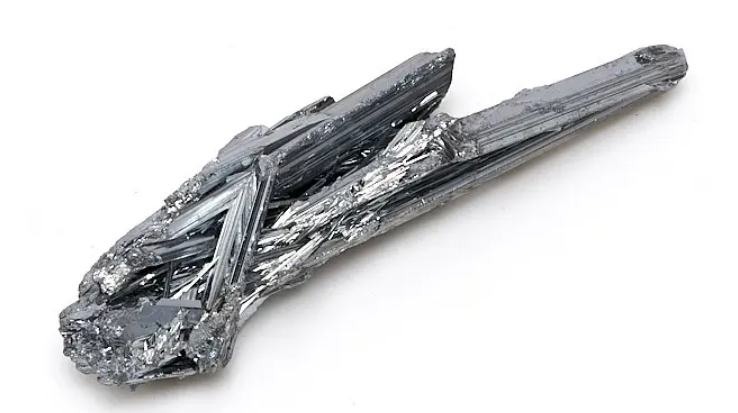
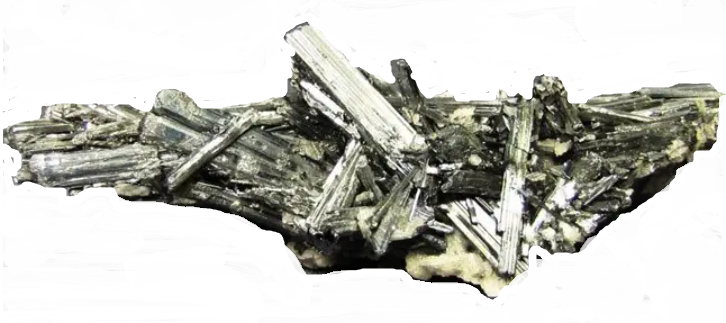
Stibnite crystals are elongated, prismatic or columnar with vertical striations; well-faceted druses occur. They can form fan-shaped intergrowths or granular and fibrous aggregates. They are characterized by excellent lengthwise splitting, flexibility, and opacity.The unit cells are orthorhombic. Fracture of a fracture. Gray color, shades from steel to dark lead, metallic luster, bluish tint. Changes color when heated (a property of temper colors).
| Property | description |
|---|---|
| Formula | Sb2S3 |
| Hardness | 2 - 2.5 |
| Impurities | As, Bi, Pb, Fe, Cu, Au, Ag |
| Density | 4.5 - 4.6 g / cmXNUMX |
| Crystal system | Orthorhombic |
| Fracture | Uneven |
| Cleavage | Quite perfect on {010} |
| Glitter | Metallic |
| transparency | Opaque |
| Color | Lead gray |
Main chemical composition:
- 71.38% Sb
- 28.62% S
It melts over low heat and is capable of igniting a spark (it is part of the sulfur match head).
We let it dissolve in hydrochloric acid; after decomposition, hydrogen sulfide is formed.Does not conduct electric current. It exhibits dielectric and diamagnetic properties. Its electrical resistance increases when heated.