Our interest in elephants is probably due to the fact that we have a lot in common with them. Elephants and humans have developed the largest and most complex brains in the mammalian kingdom, making us aware of the world around us, inventive, and adaptable. Elephants, like us, lead long lives and care for their relationships and families, living in communities and societies. Elephant offspring also have a long childhood during which they learn all practical life skills.
Tracing the origins takes us to Southeast Asia and India, where elephants are revered and embraced in many spiritual depictions.
The depiction of the Hindu god
Ganesha with an elephant head represents loyalty, intelligence, and strength (in Hindu tradition, elephants are considered sacred animals and are a national treasure of India). Generally, Ganesha is considered the god of luck, success, and wisdom. The Vedic god Indra is most often seen with a strong white elephant by his side (the god of thunder, rain, rivers, and lightning).
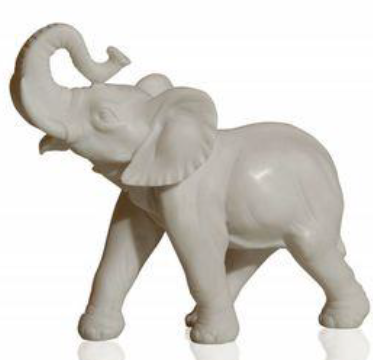
In twentieth-century American society, the deity receded into the background, and the elephant itself came to the forefront.Many believe that the depiction of an elephant with its trunk raised will "shower" us with blessings and good luck and prevent the outflow of money - for this reason, elephant statues or tapestries with elephants are commonly placed near entrance doors.
THE ELEPHANT SYMBOL IN BUDDHISM
For Buddhists, the elephant symbol represents mental strength and awakening; it appears in the role of a spiritual guide helping us on our journey.That requires patience. At the beginning of the journey to enlightenment, the mind is depicted as a wild gray elephant, unpredictably tearing down everything in its path. Only after we begin to recognize the magnitude of our mind and start the process of enlightenment does the image of the elephant in our mind transform into a white elephant, focused on the true meaning of our life. By taming the mind, we tend to strengthen the image of the elephant and direct thoughts towards solving and choosing our own reality.
In other words – merely possessing strength is not enough; we should be able to moderate our strengths and work with a focus on a clear and well-defined goal.
The elephant tells us to remain determined to achieve these goals and to accept the existence of obstacles that we must overcome with the help of our abilities. Similarly, we should be able to listen to messages from higher realms. When we cannot find a solution within available resources, listening to and trusting our intuition can clarify the path.
ELEPHANTS ACCORDING TO FENG SHUI
Chinese Feng Shui draws on certain Buddhist postulates in which the elephant is a powerful heavenly creature carrying Buddha’s jewel of fulfilled wishes – the finding of inner peace, balance, or a sense of fulfillment in life. In Feng Shui philosophy, the elephant is used in more detail, and the chosen elephant should fit well into the intended space.Apart from the material, the color scheme or their number also matters here:
- a red elephant helps communication and is more suitable for the workspace
- a richly decorated, silver, gilded, or embellished elephant is usually an elephant of fertility
- two blue elephants placed in front of the entrance to a room protect children from danger
- an elephant in black is a protector against jealous and envious outsiders
- the yellow elephant Fuk Luk Sau especially supports women, gives energy, and harmonizes relationships
- a blue elephant with six tusks accompanied by a blue rhinoceros protects against thieves, accidents, and losses
ELEPHANTS IN THE CHRISTIAN FAITH
In Christianity, the symbol of the elephant signifies moderation, chastity, and patience.They are depicted in various ancient artworks and are believed to represent Adam and Eve in their male and female forms. It was once also assumed that elephants do not have knees and therefore symbolize the "fall of man." The fallen elephant represented a person who had fallen into sin.
ELEPHANTS IN AFRICAN MYTHOLOGY
In African mythology, the elephant is depicted as a wise chief who can objectively settle disputes among other animals, which has resulted in its symbolic meanings of strength, power, and wisdom.
ELEPHANTS IN CELTIC SYMBOLISM
In Celtic culture, elephants were mostly foreign (similarly to the Native Americans), and the only example can be found in one discovered text, according to which an elephant was used by King Antiochus I. Sótér in battle to the surprise and terror of his enemies.Subsequently, the elephant took a position in the Celtic symbolic pantheon associated with military strategy.
DREAMS OF ELEPHANTS
The presence of elephants in dreams usually expresses loyalty, intellect, strength, and power.It can mean a reminder of something so that we don't forget something essential, or conversely, holding onto certain memories for too long that need to be left in the past.Dreaming of a baby elephant may symbolize a problem that currently doesn't seem very important, but over time could grow into a challenging issue. A dream about an elephant can also tell us that we need to have more patience and understanding towards other people.
WITH AN ELEPHANT TOWARD HAPPINESS AND PERSONAL GROWTH
The elephant is meant to bring happiness into our lives, and each of us imagines that in our own way based on our journey through life. If you get an elephant, it is primarily up to you what it will look like. The depiction of elephants is diverse and some people may favor, for example, a precious piece, another will get an elephant without ostentatious decoration, some prefer wood while others prefer stone or fabric, just as some are satisfied with one elephant and another gradually acquires several more. Finding happiness and life satisfaction, however, does not lie in an elephant figurine outside of us - it requires deep self-knowledge and self-discipline. Elephant figurines can be great companions on this journey.

/search_thin.svg)

/user.svg)
/cart.svg)


/heart.svg) Favorite
Favorite/compare.svg) Compare
Compare