/search_thin.svg)

/user.svg)
/cart.svg)
E-mail: info@energetickekameny.czTelefon: +420 606 647 298
CROCOITE / CROCOITE, self-confidence – inner harmony – vitality – creativity
CROCOITE / CROCUS / SIBERIAN RED LEAD / CROCOITE / STONE PROPERTIES, OPTIMISM - SEX APPEAL - VITALITY
- has a very positive effect on its owner's mood, giving them optimism and wit
- protects against envy and slander, develops talent, attracts attention and success
- thanks to the gemstone's magical properties, a person gains the attention of others, charm, and eloquence
- activates the whole organism, stimulates creativity, and increases passion
Women should use the mystical powers of crocoite with caution, because it gives them extremely high sex appeal and there may be many overly obsessed and annoying admirers around.
In this regard, the gemstone is useful for women who do not have elegant external features but want to be popular with the opposite sex.- If you place it in your bedroom, your love life will take on a whole new dimension.
- Earrings with crocoites reveal their owner's rhetorical abilities and acting talent.
- A ring with this mineral helps develop musical inclinations, sharpens hearing, and softens the voice.
- Crocoite pendants have the strongest and most powerful effect; they are believed to stimulate a person's development in all available directions.
- Talismans and amulets with the mineral are actively used by creative people who are closely connected with art.
HEALTH EFFECTS
Long ago, people believed that crocoite could cure female infertility. Although it is not as strong, the gemstone is now believed to have a positive effect on the reproductive system and helps maintain women's health and avoid problems in the gynecological area.
- it is also used to prevent diseases of the urogenital system and to normalize bowel function
- thanks to its bright and rich color, it has a positive effect on a person's mental abilities, giving them energy, vitality, and optimism
CLEANSING AND CHARGING
- the stone is soft, fragile, and fades in direct sunlight; you must take careful care of it
- place it under a stream of lukewarm running water, thinking about washing away everything negative from it; the washing time is intuitive, and you will know yourselves whether the stones are already energetically clean
- after washing, dry your stones very gently and carefully with a soft, clean cloth
- if you have the opportunity, we recommend cleansing the stones using water in nature, for example in a stream, river, waterfall, or ocean; you can place the bracelet in a permeable pouch and tie it near the shore so that water can flow through it and carry everything away
- you can also cleanse them by placing them in a bowl of water with clear quartz; to enhance the cleansing effect of the water, you can also add sage, lavender, or basil
ZODIAC SIGNS
- Crocoite is suitable for all zodiac signs except Aries: their sense of self-importance will fade.
- The stone is especially suitable for shy people: it will make it easier for them to establish new contacts and communicate with strangers.
COLOR
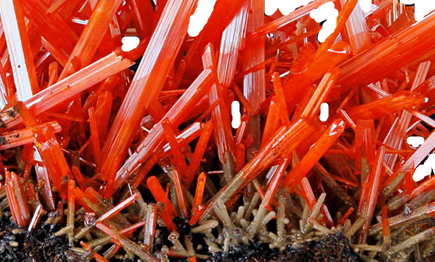
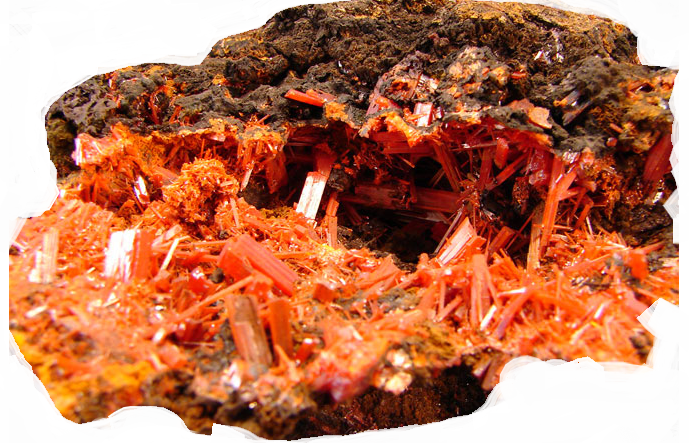
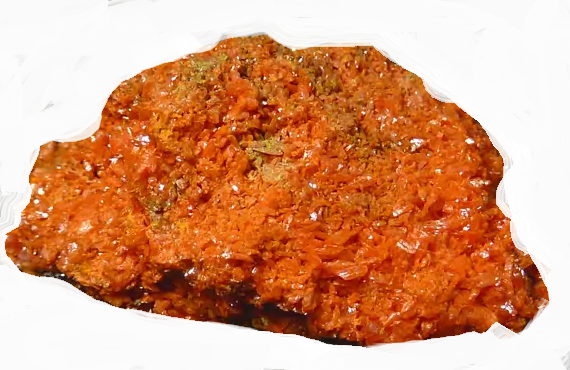
- it is a transparent or translucent crystal with a bright, almost diamond-like luster.
- small crystals are needle-like, large crystals are prism-like with longitudinal stripes along the edges.
- the basic color is yellow-orange. The shades range from softly orange to crimson with a brownish tint, through rich orange to deep burgundy.
SITE
Crocoite is a rare mineral that was first discovered in Russia and has since been found only in a small number of other locations around the world.Its most remarkable occurrence is in the Dundas area on the west coast of Tasmania, where the largest, highest-quality crocoite crystals in the world have been obtained; the dimensions of the intergrowths are mostly up to 3 cm. In the Urals, specimens are found to be twice as long; Tasmanian ones reach 15–40 cm.The raw materials of each deposit can be distinguished by color.
Crocoites are mined in many parts of the Earth:
- Philippines, America, Germany, Austria, France, England, Australia (Tasmania). Russian stone deposits are concentrated in the Urals.
HISTORY AND TRADITION
As the first mineral, it was discovered by the famous German chemist Johann Lehmann. When he became a member of the Russian Academy in 1761, he received an offer to explore the potential of the Urals (specifically the Berezovsky mine). And five years later, he uncovered a massive red stone saturated with lead.
The term crocoite is a modern, slightly modified name for the mineral “crocois,” which was given to the stone by the French mineralogist François Sulpice Beudan. It was derived from the mineral’s characteristic bright orange color, which reminded the scientist of the spice saffron. The Latin name of this flower is written as "crocus". Crocoite also had other names. For example, when it was first discovered in 1766, mining advisor Johann Gottlob Lehmann recorded crocoite under the name Siberian red lead.
Then Leman ground the stone into powder and mixed it with oil, thereby obtaining an unusually bright (and inexpensive) red color.
But the story did not end there, because one-third of the stone’s composition remained a mystery to scientists.
The Frenchman Louis-Nicolas Vauquelin undertook to solve it. The result of the multi-stage process was the production of brightly shiny needles made of a metal unknown to science. They called it chrome. No less interesting is the origin of the mineral's name. The professional community nicknamed him “Lemanita”. Since 1823, due to its resemblance to the crocus (or saffron), it became known as crocoisite, only to be renamed a few years later to the more harmonious crocoite.In German-speaking countries, it is poetically called “dawn”.
PHYSICAL AND CHEMICAL PROPERTIES
The mineral crocoite is, according to chemical classification, lead chromate.
| Formula | PbCrO4 |
|---|---|
| Color | orange-red |
| Streak color | orange |
| Luster | diamond, greasy |
| Transparency | Translucent |
| Hardness | 2.5-3 |
| Cleavage | Transparent |
| Fracture | Conchoidal, uneven; brittle |
| Density | 5.9 - 6.1 g / cm |
| Crystal system | Monoclinic |
The basic composition and formula are diversified by impurities of zinc (this variety of crocoite is also called iossaite), silver, and others.
Recently visited products