FLUORESCENT MINERALS - Get to know minerals and rocks that “glow” under ultraviolet light
What is a fluorescent mineral?
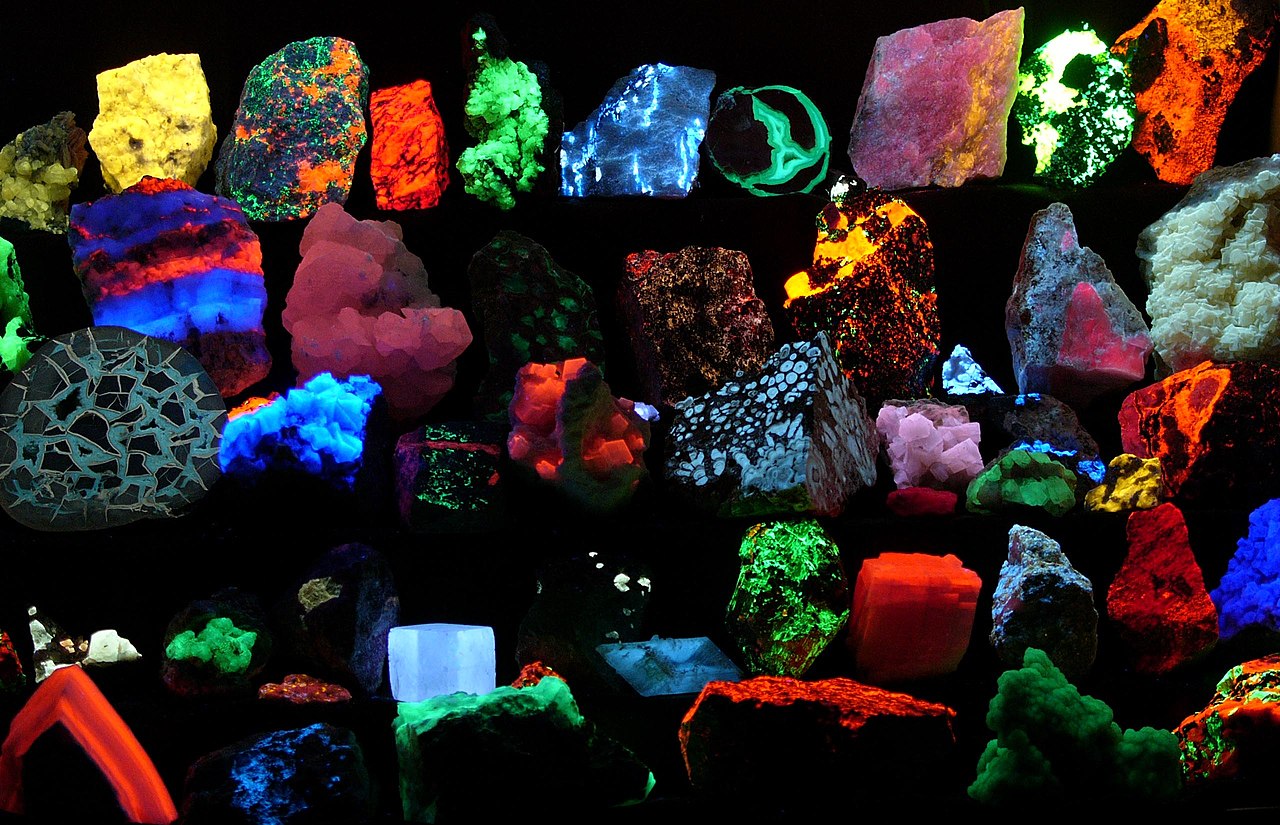
All minerals have the ability to reflect light.Thanks to this, they are visible to the human eye.Some minerals have an interesting physical property known as “fluorescence”.These minerals have the ability to temporarily absorb a small amount of light and, at a later moment, release a small amount of light of a different wavelength.This change in wavelength will cause a temporary change in the color of the mineral in the eye of the human observer.
Fluorescence in more detail
Fluorescence in minerals occurs when a sample is illuminated with specific wavelengths of light.Ultraviolet (UV) light, X-rays, and cathode rays are typical types of light that trigger fluorescence.These types of light have the ability to excite sensitive electrons in the atomic structure of the mineral.These excited electrons temporarily jump to a higher orbital in the mineral's atomic structure.When these electrons fall back to their original orbital path, a small amount of energy is released in the form of light.This release of light is known as fluorescence.
The wavelength of light emitted by a fluorescent mineral often differs significantly from the wavelength of the incident light.This will cause a visible change in the color of the mineral.This "glow" continues as long as the mineral is illuminated by light of the correct wavelength.
How many minerals glow under UV light?
Most minerals do not have pronounced fluorescence.Only about 15% of minerals have fluorescence that is visible to humans, and some specimens of these minerals will not fluoresce. Fluorescence usually occurs when specific impurities known as “activators” are present in a mineral.These activators are typically metal cations, such as: tungsten, molybdenum, lead, boron, titanium, manganese, uranium, and chromium.It is also known that rare earth elements, such as europium, terbium, dysprosium, and yttrium, contribute to the phenomenon of fluorescence.Fluorescence can also be caused by defects in the crystal structure or organic impurities.
In addition to impurities of the “activator,” some impurities have a quenching effect on fluorescence.If iron or copper are present as impurities, they may reduce or eliminate fluorescence.Moreover, if the activator mineral is present in large quantities, it can reduce the fluorescent effect.
- Most minerals fluoresce in one color.
- It is known that calcite fluoresces red, blue, white, pink, green, and orange.
- It is known that some minerals exhibit multiple fluorescence colors in a single specimen.These may be banded minerals that exhibit several phases of growth from original solutions with changing composition.
- Many minerals fluoresce one color under shortwave UV light and a different color under longwave UV light.
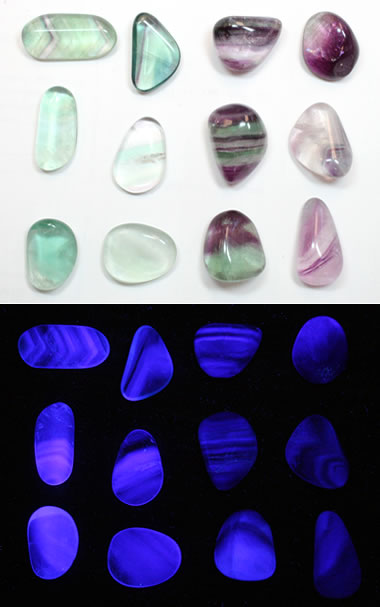
Fluorite: Tumbled fluorite samples in normal light (top) and under short-wave ultraviolet light (bottom).It seems that fluorescence is related to the color and banded structure of minerals in ordinary light, which could be connected to their chemical composition.
Fluorite: The Original "Fluorescent Mineral"
One of the first people to observe fluorescence in minerals was George Gabriel Stokes in 1852. He noticed fluorite's ability to produce a blue glow when illuminated by invisible light "beyond the violet end of the spectrum."He named this phenomenon "fluorescence" after the mineral fluorite.
- Many fluorite samples have sufficiently strong fluorescence that an observer can take them outside, hold them in sunlight, then move them into the shade and see the color change.
- Only a few minerals have this level of fluorescence.
- Fluorite typically glows blue-violet under shortwave and longwave light.
- Some specimens are known to glow cream or white.
- Many samples do not fluoresce.It is assumed that fluorescence in fluorite is caused by the presence of yttrium, europium, samarium, or organic material as activators..
Fluorescent geodes?
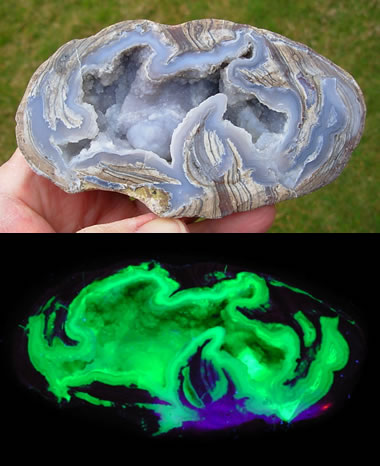
You may be surprised to learn that some people have found geodes with fluorescent minerals inside.Some of the Dugway geodes, located near the town of Dugway in Utah, are lined with chalcedony that produces lime-green fluorescence caused by trace amounts of uranium.
Dugway geodes are amazing for another reason.They formed several million years ago in gas pockets of a rhyolite bed.Then, about 20,000 years ago, they were eroded by wave action along the shore of a glacial lake and transported several miles away, where they eventually came to rest in lake sediments. Today, people dig them up and add them to collections of geodes and fluorescent minerals.
Fluorescent spodumene:
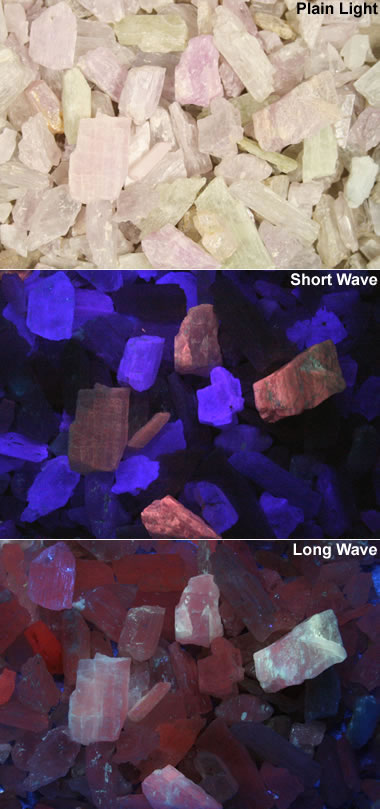
- This spodumene (the gemstone variety kunzite) provides at least three important lessons in mineral fluorescence.All three photographs show the same range of specimens.The top is in normal light, the middle is in short-wave ultraviolet, and the bottom is in long-wave ultraviolet.
Lesson:
- 1) one mineral can fluoresce in different colors;
- 2) fluorescence can have different colors under shortwave and longwave light;
- 3) some mineral specimens will not fluoresce.
Practical use of mineral and rock fluorescence
Fluorescence has practical applications in mining, gemology, petrology, and mineralogy.The mineral scheelite, an ore of tungsten, typically has a bright blue fluorescence.Geologists searching for scheelite and other fluorescent minerals sometimes look for them at night using ultraviolet lamps.
Geologists in the oil and gas industry sometimes examine drill cuttings and cores using UV lamps.Small amounts of oil in the pores of the rock and mineral grains contaminated with oil will fluoresce under UV light.The color of fluorescence can indicate the thermal maturity of the oil, with darker colors indicating heavier oils and lighter colors indicating lighter oils.
Fluorescent lamps can be used in underground mines to identify and track ore-bearing rocks.
They were also used on sorting lines to quickly locate valuable pieces of ore and separate them from waste.Many gemstones are sometimes luminescent, including ruby, kunzite, diamond, and opal. This property can sometimes be used to find small stones in sediment or crushed ore.It can also be a way to connect stones with the mining site.
For example: light yellow diamonds with strong blue fluorescence are produced by the South African Premier mine, and colorless stones with strong blue fluorescence are produced by the South African Jagersfontein mine.The stones from these mines are nicknamed “Prime Ministers” and “Jagrs”.
At the beginning of the 20th. For centuries, many diamond merchants sought stones with strong blue fluorescence.They believed that these stones would appear more colorless (less yellow) when viewed under light with a high ultraviolet content.This ultimately led to controlled lighting conditions for diamonds with color grading.
Fluorescence is not commonly used in mineral identification.Most minerals are not fluorescent, and the property is unpredictable.A good example is calcite.Some calcite does not fluoresce.Fluorescent calcite samples glow in various colors, including red, blue, white, pink, green, and orange.Fluorescence is rarely a diagnostic property.
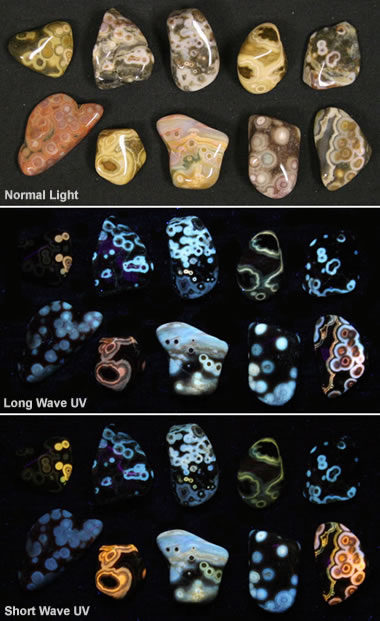
Fluorescent Ocean Jasper: This image shows some pieces of tumbled ocean jasper under normal light (top), longwave ultraviolet (middle), and shortwave ultraviolet (bottom).It shows how materials react to different kinds of light.Samples and photographs by RockTumbler.com, partner sites of Geology.com.
Other properties of luminescence
Fluorescence is one of several luminescent properties that a mineral may exhibit.Other luminescent properties include:
PHOSPHORESCENCE In fluorescence, electrons excited by incoming photons jump to a higher energy level and remain there for a tiny fraction of a second before returning to the ground state and emitting fluorescent light.During phosphorescence, electrons remain in the excited orbital state for a longer time before they fall back.Fluorescent minerals stop glowing after the light source is turned off.Minerals with phosphorescence may glow for a short time after the light source is turned off.Among the minerals that are sometimes phosphorescent are calcite, celestite, colemanite, fluorite, sphalerite and willemite.
Thermoluminescence is the ability of a mineral to emit a small amount of light when heated.This heating can be to temperatures as low as 50 to 200 degrees Celsius - much lower than the glowing temperature.Apatite, Calcite, Chlorophane, Fluorite, Lepidolite, Scapolite and some feldspars are occasionally thermoluminescent.
TRIBOLUMINESCENCE
Some minerals will emit light when mechanical energy is applied to them.These minerals glow when they are struck, crushed, scratched, or broken.This light is the result of broken bonds in the mineral structure.The amount of emitted light is very small and careful observation in the dark is often required.Among the minerals that sometimes exhibit triboluminescence are Amblygonite, Calcite, Fluorite, Lepidolite, Pectolite, Quartz, Sphalerite and some feldspars. 
/search_thin.svg)

/user.svg)
/cart.svg)

/heart.svg) Favorite
Favorite/compare.svg) Compare
Compare