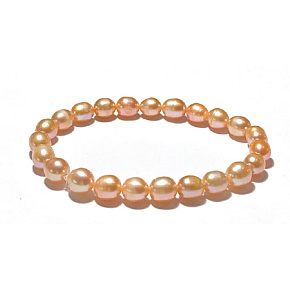
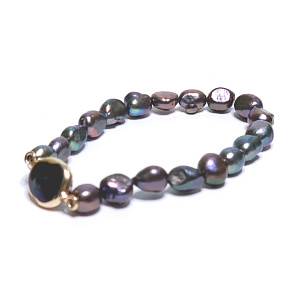
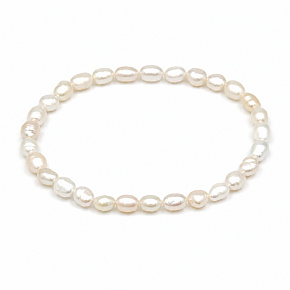
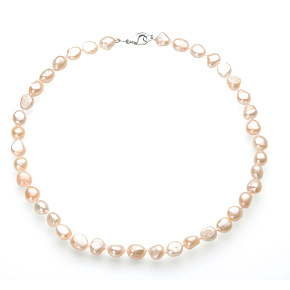
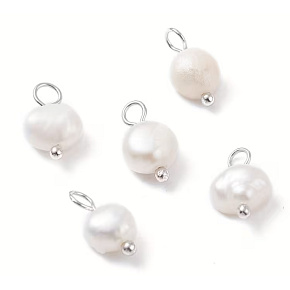
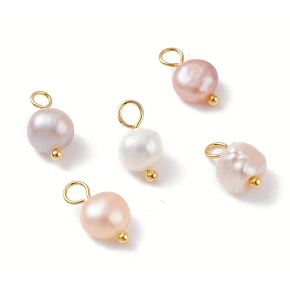
PEARL OF ABILITY, A SYMBOL OF BEAUTY - ATTRACTIVENESS - FEMININITY - HAPPINESS - RECOGNITION - ADMIRATION
They bring the admiration of men and the respect of those around them. They are associated with success and recognition. They bring a good standing for women as mothers, wives, colleagues, and bosses...Pearls are the most beautiful gift for a woman in life.
Since time immemorial, pearls have been associated primarily with love, they attract love, are linked with pure love, heal the heart chakra, are the gemstone of the sea and rivers, a symbol of purity and transformation
People believed that white and pink pearls came from Eve's tears. The rarer and more expensive black pearls were formed from Adam's tears.
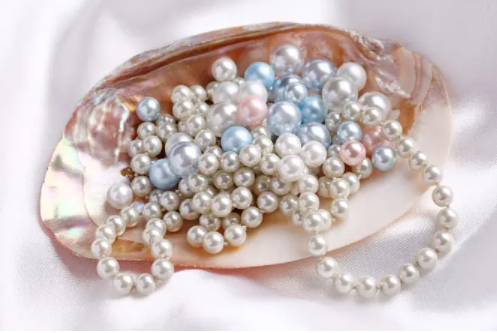
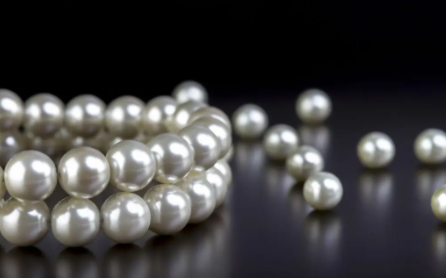
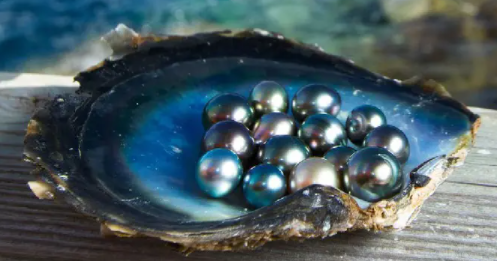
- attracts good fortune and love, strengthens relationships
- a symbol of great wealth, wisdom, and grace
- has a calming and soothing effect, balances karma
- ensures a happy married life and fidelity - protects a mature woman from the evil eye, harm, and adultery
- gives courage
- soothes the heart chakra
- for people born under the sign of Cancer, balances fluctuating emotions
In ancient legends, Pearls were the tears of the gods, representing tears falling from heaven, or simply the reflection of the moon.
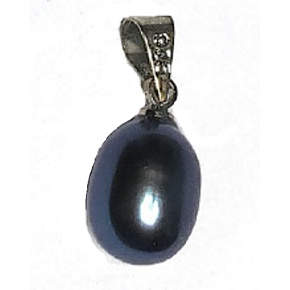
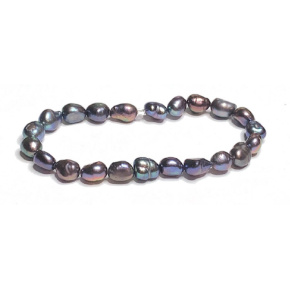
PEARL OF PEACOCK ABILITY
- a symbol of mystery, independence, and strength
- supports partnership cohesion as well as marital harmony
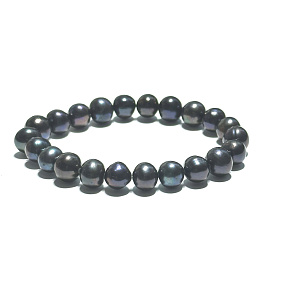
BLACK PEARL OF ABILITIES
- not recommended for unmarried girls
- symbolizes wisdom
- the black pearl had a reputation for exceptional value and rarity.
However, only the royal family and the nobility could afford to wear them - which is why the natural black pearl began to be referred to as the pearl of queens and also as the queen of pearls
HEALTH EFFECTS - this stone IS endowed with significant diagnostic properties.
- loss of luster, discoloration, and clouding of pearls may indicate the onset of a serious tumor process in the abdominal organs. In such a case, the owner of pearl jewelry should consult a doctor immediately
- patients suffering from arrhythmias, liver disease, and gastrointestinal tract disorders. A pendant with a large pearl will help alleviate their condition
- people who complain of emotional overload and frayed nerves are advised to wear pearl beads or a bracelet
Mother-of-pearl tincture has an excellent hemostatic, antibacterial, and anti-inflammatory effect. To obtain it, 3–4 pearls are placed in a glass of cold water and left to steep for 12 hours. Using it as an eye rinse can help you get rid of conjunctivitis, and regular mouth rinsing can help heal sore gums.
CLEANING AND CHARGING
- Pearls are cleaned briefly under running water and immediately dried with a soft cotton cloth
- Pearls are charged on crystal in indirect sunlight or moonlight
Pearls have a porous surface layer prone to mechanical damage and also easily lose their luster.
Ideally, gently wipe the pearl with a soft cloth after each use. Protect pearls from contact with cleaning agents, cosmetic products, and perfumes. Use perfume before putting on jewelry. There are special cleaning solutions for pearls, but lukewarm water with a drop of shampoo will also suffice.
Clean pearl jewelry by simply applying a sponge or a soft cloth that you have soaked in soapy water. After washing, let the pearls dry on a flat surface. Pearl necklaces and bracelets should not be hung to prevent the silk thread on which the pearls are strung from stretching.
The loss of luster in pearls can be caused by contact with acidic environments, chemicals, or loss of moisture.
We will reveal a simple trick on how to restore the shine of pearls. First, rinse the pearls with clean water and gently dry them or let them air dry. Rub each individual pearl with a small amount of natural oil. After one minute, carefully dry the remaining oil with a paper towel
TALISMAN: Pearls are among the stones that become accustomed to their wearer.
For a stone used as a talisman or amulet to work exclusively for its owner and not harm them, it should be worn in accordance with the following rules:
- Accepting pearls as a gift from strangers is strictly forbidden, as it may lead to misfortune.
- Jewelry gifted by a loved one will bring its new owner good luck only if it is paired (for example, a set consisting of earrings and a bracelet) and the giver’s intentions are kind and sincere. Otherwise, the pearl energy will be negative.
- Talismans that have been used for a long time should not be redistributed or inherited, because pearls that have retained the energy of the previous owner do not always accept a new owner. In such a case, it may become lost or crack.
- A frequently used pearl talisman needs regular recharging: for this purpose, it is placed in a glass of clean water, taken outside, and left in a place flooded with moonlight for 15 minutes
Pearls - the rule applies to them: last on, first off. It cannot stand contact with perfume, hairspray, and other chemicals - it loses its shine. We do not bathe in them (they hate boiling water, salt water).
DEPOSIT
- The pearl, a stone that is an amazing gift of living nature and is not mined from the depths of the Earth but from the bottoms of large bodies of water (oceans and seas), has been used by human society for several millennia and is revered as the most extraordinary jewel.
According to records, the pearl was known as early as 6 thousand years ago.Gemologist George Frederick Kunz stated that it was discovered off the coast of India by fishermen who noticed that the sea had washed up a strange object.
In the previous century, the price of pearls was 4 times higher than the price of gold. At the beginning of the 20th. In that century, pearl hunting, besides gold mining, was a highly lucrative opportunity for easy and quick enrichment.
HISTORY AND LEGENDS
Did you know that pearls are the only gemstone that comes from a living organism?
- Mongolian rulers drank a pearl decoction because they believed it would strengthen their virility.
- In India, pearls were worn as a talisman, and Indian warriors decorated their protective shields with them to protect themselves from injuries.
- The Chinese, on the other hand, attributed healing effects to pearls. They made a pearl drink from pearls, which they used for healing, and even as an elixir of youth. The Chinese also used to say that black pearls symbolize wisdom, and they believed that pearls fall from the sky and are created by a dragon. They believed that in order for a person to catch a pearl, they first had to kill the dragon that held the pearls tightly between its teeth.
- In ancient China, the pearl adorning every nobleman's hat emphasized his high status.
- The Greeks and Romans believed that wearing pearls promotes partnership cohesion as well as marital harmony, and also that the memorable bond between Psyche and Cupid was depicted as a string of pearls. However, the Romans also considered pearls a symbol of great wealth, wisdom, charm, and good fortune. Ladies wearing pearl necklaces slept so that they would have pleasant dreams.
- About Venus, the Roman goddess of sensuality, beauty, and love, it was in turn said that she was born from a sea oyster, just like a pearl.
- Beautiful Aphrodite - The Greek goddess of beauty and love was born by emerging from a shell. Her beauty and elegance are like pearls.
- The Japanese, in turn, believed that pearls were formed from the tears of mythical beings – mermaids, fairies, and angels. The ancient Egyptians valued their pearls so highly that they were buried with them. And Queen Cleopatra? She supposedly dissolved a pearl from one of her earrings in a glass of vinegar and drank it. By this, she wanted to prove to Mark Antony that she could consume the wealth of an entire nation in a single sip.
- Cleopatra and Antony - One day, they made a bet about who could host the more luxurious celebration. Cleopatra appeared at the celebration wearing earrings adorned with pearls. Antonius found nothing extraordinary about the event and asked the queen to show him the bill. Cleopatra, to secure a certain victory, took a pearl from her earring, dissolved it in vinegar, and, thanking Antony, drank the resulting beverage, thereby demonstrating how vain her amusement was. There have been many attempts to prove the authenticity of this legend. In a scientific experiment, Cleopatra's piece was replicated. A real pearl, crushed into powder, dissolved in acetic acid within a few minutes, and the "pearl cocktail" could be drunk. According to some, the queen soaked her pearl earrings in vinegar several days earlier, so they dissolved more quickly when she put them into the glass. The referee clearly awarded the victory to Cleopatra. The remaining pearl was cut in half, and because it was so enormous, another pair of earrings was made from it. The earrings were then offered to Venus, the goddess of love.
- Legend has it that Cleopatra removed a pearl from one of her earrings and dropped it into wine (or wine vinegar – depending on the source), which she then drank. She allegedly wanted to show Mark Antony that she could swallow the wealth of an entire nation in a single gulp.
- Alexander the Great, who became the owner of countless treasures acquired as a result of his campaigns to the East, sparked a pearl craze that lasted two centuries and made pearls extraordinarily popular among the nobility of the time.
- The La Peregrina Pearl - One of the most famous pearl jewels is the La Peregrina necklace, which was gifted by King Philip II. The Spaniard to his wife Mary Tudor as a gift for their wedding. It was first depicted in a painting from 1554. It is known about the pearl from the necklace that it comes from South America. According to legend, it was discovered by one of the slaves on the coast of Panama, and in exchange for it he regained his freedom.What is certain is that from the age of 16. century became a jewel of the Spanish royal treasury. She appeared in the courtyard of Versailles in the 17th century. century, when it adorned the hat of the King of Spain at his daughter's wedding.
- Prince Svyatoslav, as chroniclers attest, wore a pearl earring in one ear. The cloak of Ivan the Terrible, embroidered with pearls, amazed foreign ambassadors with its beauty and richness.
- In memory of the miraculous drink, guests of the modern Japanese Hotel Otani are offered the chance to taste the Pearl cocktail: together with a glass of wine, they receive a pearl resting on a rose petal.
- Like other gemstones, pearl colors also have their hidden meaning. Blue pearls signify that their wearer will find love, black and gold pearls refer to wealth and prosperity, pink ones to success, fame, and Fortune's favor, and brown ones to practicality, masculinity, reliability, and harmony. White pearls symbolize innocence, grace, purity, and a new beginning.
- Since the Middle Ages, pearls have been considered sacred Christian objects because they are associated with religious purity. The first believers even believed that the Holy Grail was covered with pearls of pure water.
- True natural pearls have been found for thousands of years in the Persian Gulf, the Gulf of Mannar (Indian Ocean), and the Red Sea. Polynesia and Australia became famous for cultured pearls. Freshwater and saltwater pearls are cultivated primarily in Japan and China. Freshwater pearls are also found in rivers in Scotland, Ireland, France, Austria, Germany, and the USA (Mississippi).
- Pearl is considered the birthstone of all those born in June under the sign of Gemini. Pearls are suitable as a gift for the 3rd. and 13. anniversary.
- The oldest written mention of pearls comes from Chinese sources dating to 2206 BC. n. l. The Chinese were also the first to attempt to cultivate pearls, but they did not achieve significant success in pearl cultivation until the beginning of the 20th century. century Japanese.
- In 1917, Pierre Cartier exchanged a double strand of natural pearls for a mansion on Fifth Avenue. Avenue in New York.
- If you are buying or have real pearls at home, you can recognize them with a simple trick. Run the pearls across your teeth – if you feel irregularities and bumps, they are genuine; if they are completely smooth, you own a fake.
- In May 1934, a tragedy occurred off the coast of Palawan Island (the Philippines): a young pearl fisherman died after becoming trapped by a giant clam (mollusk) that clamped onto his hand. The diver's body was brought out of the sea and the shell's valves were opened—the cause of his death. Inside was a huge pearl with a diameter of 23.8 cm and a weight of 6 kg 370 g. The local mullah, who saw in its intricate shape a resemblance to the head of a man in a turban, gave it the name “Pearl of Allah”. The value of the treasure (this pearl is considered the second largest in the world) - despite the absence of a pearly luster - is 40 million dollars. According to unverified reports, his repository is in New York.
- In 2010, one of the local fishermen was lucky enough to catch a giant clam in the same places, inside which a pearl weighing 34 kg had formed. Its owner, who was remarkable for his modesty, kept it in his house as a talisman. The discovery became known only after a fire in the house of a successful fisherman.The cost of the unique pearl - according to preliminary calculations - amounts to 100 million dollars.
- A radiant orange melo pearl measuring 23x18 mm was auctioned by Christie’s in 1999 for 488 thousand dollars.
AUTHENTICITY OF THE PEARL
- light reflects iridescently from genuine cultured pearls, whereas from fake ones it reflects glassily, and on the surface of real pearls you can see small imperfections, an uneven surface, and changing luster
- a generally known method is also "biting the pearl"; it really works, apparently we try to bite into the pearl, and if the sensation resembles biting into sand, then the pearl is genuine.
However, if it feels smooth to the bite, resembling plastic, then unfortunately we are not biting into a real pearl - a cultured pearl has a grainy texture, while fake pearls glide gently and smoothly
FORMATION OF A PEARL
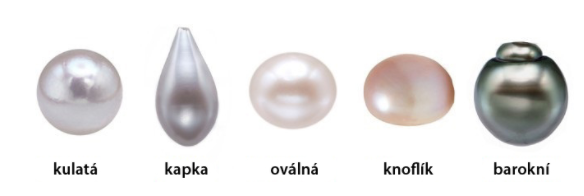
A pearl is a small shiny spherical object formed inside a pearl oyster, a sea oyster, or a freshwater mussel. Like pearl mussels, pearls are also formed from layers of calcium carbonate. Ideal pearls are perfectly round and smooth, but most natural pearls form in various irregular shapes and colors (baroque pearls). Pearls are valued primarily in jewelry making.
Natural pearls are formed when a foreign body enters the shell of a mollusk – for example. a grain of sand. This triggers a defensive reaction, which begins to secrete nacre that settles on the foreign body. Only one pearl can grow in a single shell at a time. Natural pearls are very rare and more or less sought after depending on the quantity, quality, and shape of the nacreous material.
Most pearls currently sold come from farms. These pearls are formed similarly to natural pearls, with the difference that the foreign body is intentionally introduced into the shell. The growth period of a pearl ranges from one year to several years. The main pearl farming regions include China, Japan, Tahiti, and Vietnam.
Several basic types of pearls can be distinguished:
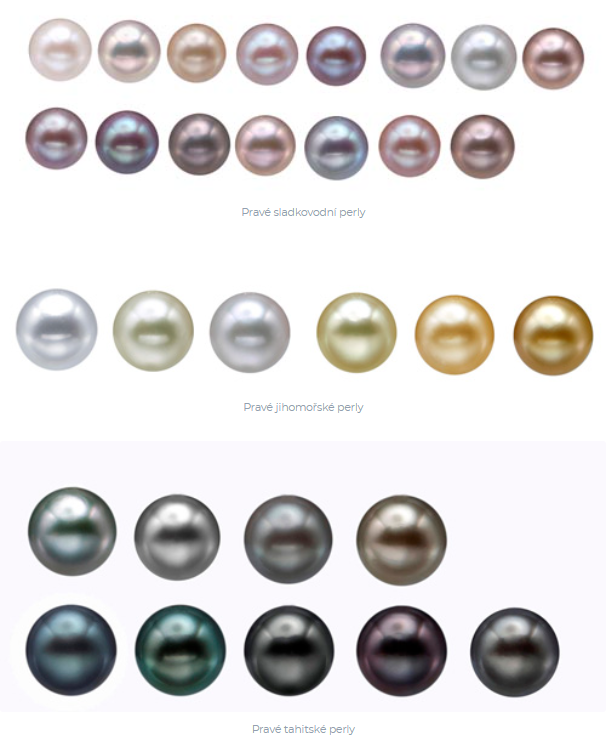
- Akoya pearls come from China, Vietnam, or Japan. They are usually 5 to 9 mm in size, and their color can vary: cream, pink, silvery, or green. In the warmer coastal waters of China, pearls can grow up to twice as fast as in the cooler waters of Japan.
- Tahitian pearls are produced by a special species of black-lipped oysters found in the region of French Polynesia. These pearls are also rare because only a small proportion of these oysters survive in farms. Individual pearls differ considerably from one another, so for example to assemble the necklace, hundreds of them need to be sorted.
- South Sea pearls are cultivated in Australia, Burma, Indonesia, and other neighboring countries. They usually measure 1 to 2 cm in diameter and are therefore sold at high prices. Their coloration is usually white, yellow, yellow-orange, or bluish; moreover, they may have a pink, green, or blue tint.Nicknamed the "Queens among pearls" or the "Pearls of queens" from the northern waters of Australia, the Philippines, and Indonesia.
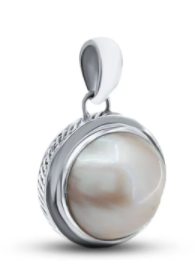
- Mabe pearls have a hemispherical shape, which is caused by the fact that they form attached inside oysters on the walls of their shells. They are cultivated in China, Japan, and the USA, and due to their shape they are used primarily for making rings and earrings, to which they are attached by their flat side.
- Kasumiga - Thanks to humans, they originate from Lake Kasumiga Ura northeast of Tokyo. The shells in which they are formed are a crossbreed of Japanese and Chinese freshwater pearl mussels. They range in color from pale pink to dark cyclamen pink.
- Keshi - Nature’s seedless curiosities, formed by chance. That is why they have very irregular shapes, and there is a wide palette of colors to choose from, ranging from silvery white to dark anthracite gray.
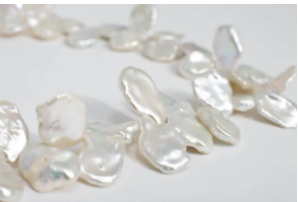
China - Freshwater non-nucleated pearls are cultivated in tributaries and canals built on the Yangtze River.Oval, round, and baroque shapes, a wide range of colors from white through orange to pink-purple.Freshwater pearls are produced, among other things. the freshwater pearl mussel. Smaller foreign bodies are used in breeding than on marine farms. Freshwater pearls are cheaper than saltwater pearls, among other reasons. because up to 20 pearls can grow simultaneously in a single pearl oyster.
Like people, pearls are subject to aging. After roughly 100–150 years, when their time has come, they die.

/search_thin.svg)

/user.svg)
/cart.svg)

/heart.svg) Favorite
Favorite/compare.svg) Compare
Compare